

Mastering Circuits!
Don’t know about the Basic Concepts of Electrical Circuits yet!
Read this: Basic Concepts of Electrical Circuits
Ready to put your theoretical knowledge to the test?
In this dedicated problem-solving guide, we dive into a wide variety of numerical problems covering the basic concepts of electrical circuits.
We will walk you through step-by-step solutions involving electric charge, current, voltage, instantaneous power, energy, and circuit elements including both independent and dependent sources.
Whether you want to master the calculus behind time-varying waveforms or perfect your application of the passive sign convention, join Mastering Circuits as we solve some numerical problems on basic concepts of electrical circuits to build your problem-solving speed and confidence.
Solved Problems on Charge and Current
In this section, we focus on the fundamental relationship between electric charge (q) and current (i) . Remember that electric current is simply the time rate of change of charge (i = \frac{dq}{dt}) , which means we can move between the two quantities using differentiation and integration (q = \int i \, dt) .
The problems below will test your ability to calculate total charge from groups of atomic particles (electrons and protons), evaluate time-dependent current equations, and analyze graphical waveforms by determining the slopes of charge vs time plots.
Problem 1
Pb-1: How much charge is represented by these number of electrons? \small \begin{aligned} \\[1ex] &\text{(a) } 6.482 \times 10^{17} \quad \quad \quad \quad \quad \text{(b) } 1.24 \times 10^{18} \\[2.5ex] &\text{(c) } 2.46 \times 10^{19} \quad \quad \quad \quad \quad \ \ \text{(d) } 1.628 \times 10^{20} \end{aligned}
Solution:
\small \begin{aligned} (a) \quad q & = 6.482 \times 10^{17} \times (-1.602 \times 10^{-19}) \ C \\ & = -0.1038 \ C \\[2.5ex] (b) \quad q & = 1.24 \times 10^{18} \times (-1.602 \times 10^{-19}) \ C \\ & = -0.1986 \ C \\[2.5ex] (c) \quad q & = 2.46 \times 10^{19} \times (-1.602 \times 10^{-19}) \ C \\ & = -3.9409 \ C \\[2.5ex] (d) \quad q & = 1.628 \times 10^{20} \times (-1.602 \times 10^{-19}) \ C \\ & = -26.0806 \ C \end{aligned}
Problem 2
Pb-2: Determine the current flowing through an element if the charge flow is given by \small \begin{aligned} \\[1ex] &\text{(a) } q(t) = (3t + 8) \ mC \\[2.5ex] &\text{(b) } q(t) = (8t^2 + 4t - 2) \ C \\[2.5ex] &\text{(c) } q(t) = (3e^{-t} - 5e^{-2t}) \ nC \\[2.5ex] &\text{(d) } q(t) = 10 \sin(120\pi t) \ pC \\[2.5ex] &\text{(e) } q(t) = 20e^{-4t} \cos(50t) \ \mu C \end{aligned}
Solution:
\small \begin{aligned} (a) \quad i & = \frac{dq}{dt} = \frac{d}{dt}(3t + 8) = 3 \ mA \\[2.5ex] (b) \quad i & = \frac{dq}{dt} = \frac{d}{dt}(8t^2 + 4t - 2) = (16t + 4) \ A \\[2.5ex] (c) \quad i & = \frac{dq}{dt} = \frac{d}{dt}(3e^{-t} - 5e^{-2t}) \\[2.5ex] & = (-3e^{-t} + 10e^{-2t}) \ nA \\[2.5ex] (d) \quad i & = \frac{dq}{dt} = \frac{d}{dt}{10 \sin(120\pi t)} \\[2ex] & = {1200\pi \cos(120\pi t)} \ pA \\[2.5ex] (e) \quad i & = \frac{dq}{dt} = \frac{d}{dt}{20e^{-4t} \cos(50t)} \\[2.5ex] & = \cos(50t) \frac{d}{dt}(20e^{-4t}) + 20e^{-4t} \frac{d}{dt}{\cos(50t)} \\[2.5ex] & = {-80e^{-4t} \cos(50t) - 1000e^{-4t} \sin(50t)} \ \mu A \end{aligned}
Problem 3
Pb-3: Find the charge q(t) flowing through a device if the current is: \small \begin{aligned} \\[1ex] &\text{(a) } i(t) = 3 \ A, \ q(0) = 1 \ C \\[2.5ex] &\text{(b) } i(t) = (2t + 5) \ mA, \ q(0) = 0 \\[2.5ex] &\text{(c) } i(t) = 20 \cos(10t + \pi/6) \ \mu A, \ q(0) = 2 \ \mu C \\[2.5ex] &\text{(d) } i(t) = 10e^{-30t} \sin 40t \ A, \ q(0) = 0 \end{aligned}
Solution:
\small \begin{aligned} (a) \quad q &= \int i dt + q(0) = \int 3 dt + 1 \\[2.5ex] & = (3t + 1) \ C \\[2.5ex] (b) \quad q &= \int i dt + q(0) = \int (2t + 5) dt + q(0) \\ \phantom{(b) \quad q} &= 2 \cdot \frac{t^2}{2} + 5t + 0 = (t^2 + 5t) \ mC \\[2.5ex] (c) \quad q &= \int i dt + q(0) \\[2.5ex] & = \int 20 \cos(10t + \pi/6) dt + 2 \\ \phantom{(c) \quad q} &= 20 \cdot \frac{\sin(10t+\frac{\pi}{6})}{10} + 2 \\[2.5ex] & = \left\{ 2 \sin\left(10t + \frac{\pi}{6}\right) + 2 \right\} \mu C \end{aligned}
\small \begin{aligned} & (d) \quad q = \int i dt + q(0) = \int 10e^{-30t} \sin 40t \ dt + 0 \\[2ex] &\phantom{(d) \quad} \therefore q = 10 \int e^{-30t} \sin 40t \ dt \quad \text{\text{-} \text{-} \text{-} (i)} \\[2.5ex] &\text{Let,} \\[2ex] &\quad I = \int e^{-30t} \sin 40t \ dt \\[2.5ex] &\text{We know,} \\[2ex] &\quad \int uv \ dx = u \int v \ dx - \int \left( \frac{du}{dx} \cdot \int v \ dx \right) dx \end{aligned}
\small \begin{aligned} &\text{Now,} \\[2ex] &\quad I = \int e^{-30t} \sin 40t \ dt \quad [\text{where, } u = \sin 40t \ ; \ v = e^{-30t}] \\[2ex] &\quad \phantom{I} = \sin 40t \int e^{-30t} \ dt - \int \left\{ \frac{d}{dt}(\sin 40t) \cdot \int e^{-30t} dt \right\} dt \\[2.5ex] &\quad \phantom{I} = (\sin 40t) \left(-\frac{1}{30} e^{-30t}\right) - \int \left\{ (40 \cos 40t) \cdot \left(-\frac{1}{30} e^{-30t}\right) \right\} dt \\[2.5ex] &\quad \phantom{I} = -\frac{1}{30} e^{-30t} \sin 40t - \int \left(-\frac{40}{30} e^{-30t} \cos 40t\right) dt \\[2.5ex] &\quad \phantom{I} = -\frac{1}{30} e^{-30t} \sin 40t + \frac{4}{3} \int e^{-30t} \cos 40t \ dt \quad \text{\text{-} \text{-} \text{-} (ii)} \end{aligned}
\small \begin{aligned} &\text{Let,} \\[2ex] &\quad J = \int e^{-30t} \cos 40t \ dt \quad [\text{where, } u = \cos 40t \ ; \ v = e^{-30t}] \\[2ex] &\quad \phantom{J} = \cos 40t \int e^{-30t} \ dt - \int \left\{ \frac{d}{dt}(\cos 40t) \cdot \int e^{-30t} dt \right\} dt \\[2.5ex] &\quad \phantom{J} = (\cos 40t) \left(-\frac{1}{30} e^{-30t}\right) - \int \left\{ (-40 \sin 40t) \cdot \left(-\frac{1}{30} e^{-30t}\right) \right\} dt \\[2.5ex] &\quad \phantom{J} = -\frac{1}{30} e^{-30t} \cos 40t - \int \left( \frac{40}{30} e^{-30t} \sin 40t \right) dt \\[2.5ex] &\quad \phantom{J} = -\frac{1}{30} e^{-30t} \cos 40t - \frac{4}{3} \int e^{-30t} \sin 40t \ dt \\[2.5ex] &\quad \phantom{J} = -\frac{1}{30} e^{-30t} \cos 40t - \frac{4}{3}I \quad \text{\text{-} \text{-} \text{-} (iii)} \end{aligned}
\small \begin{aligned} &\text{Using (iii) in (ii),} \\[2ex] &\quad I = -\frac{1}{30} e^{-30t} \sin 40t + \frac{4}{3} \left[ -\frac{1}{30} e^{-30t} \cos 40t - \frac{4}{3}I \right] \\[2.5ex] &\quad \Rightarrow I = -\frac{1}{30} e^{-30t} \sin 40t - \frac{4}{90} e^{-30t} \cos 40t - \frac{16}{9} I \\[2.5ex] &\quad \Rightarrow I + \frac{16}{9} I = -\frac{1}{30} e^{-30t} \sin 40t - \frac{4}{90} e^{-30t} \cos 40t \\[2.5ex] &\quad \Rightarrow \frac{25}{9} I = -\frac{3 \times 1}{3 \times 30} e^{-30t} \sin 40t - \frac{4}{90} e^{-30t} \cos 40t \\[2.5ex] &\quad \Rightarrow \frac{25}{9} I = -\frac{1}{90} e^{-30t} [3 \sin 40t + 4 \cos 40t] \\[2.5ex] &\quad \therefore I = -\frac{1}{250} e^{-30t} [3 \sin 40t + 4 \cos 40t] \end{aligned}
\small \begin{aligned} &\text{Using the value of } I \text{ in (i),} \\[2ex] &\quad \therefore q = -\frac{10}{250} e^{-30t} [3 \sin 40t + 4 \cos 40t] \\[2.5ex] &\quad \phantom{\therefore q} = -\frac{1}{25} e^{-30t} [3 \sin 40t + 4 \cos 40t] \ \text{C} \end{aligned}
Problem 4
Pb-4: A current of 7.4 \ A flows through a conductor. Calculate how much charge passes through any cross-section of the conductor in 20 seconds.
Solution:
\small \begin{aligned} q = it = 7.4 \times 20 = 148 \ C \end{aligned}
Problem 5
Pb-5: Determine the total charge transferred over the time interval of 0 \le t \le 10 \ s when i(t) = \frac{1}{2}t \ A .
Solution:
\small \begin{aligned} q = \int_{t_0}^t i \ dt = \int_0^{10} \frac{1}{2}t \ dt = 25 \ C \end{aligned}
Problem 6
Pb-6: The charge entering a certain element is shown in the Fig. 1. Find the current at: \small \begin{aligned} \\ \text{(a) } t = 1 \ ms \quad \text{(b) } t = 6 \ ms \quad \text{(c) } t = 10 \ ms \end{aligned}
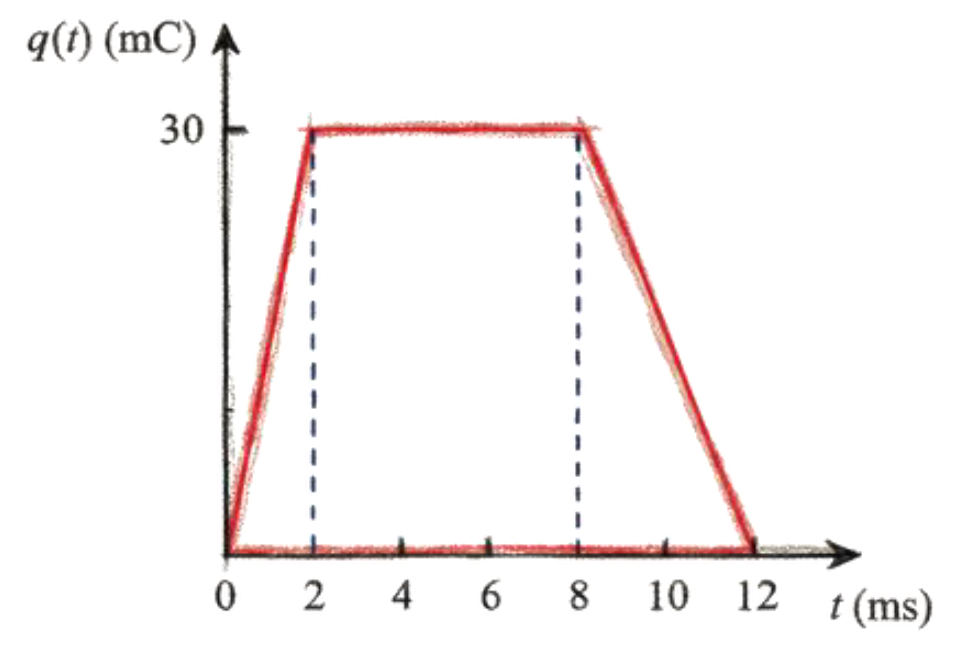
Figure 1 – Circuit diagram for Pb-6
Solution:
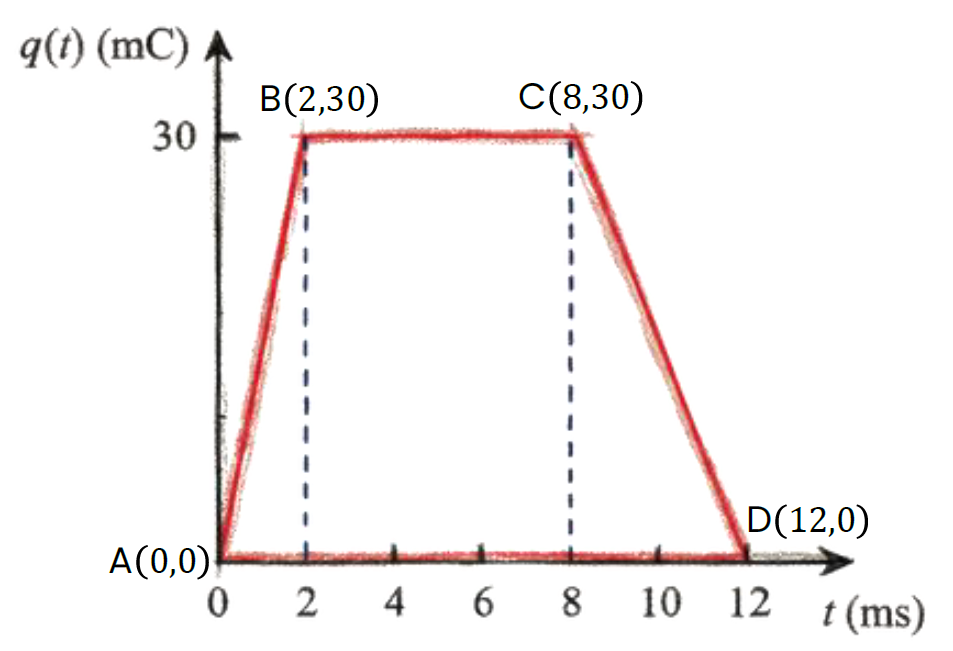
Figure 2 – Circuit diagram for solving the Pb-6
\small \begin{aligned} & (a) \ \ \text{We know,} \\[1ex] & \quad \quad \quad \text{slope, } m = \frac{y_2-y_1}{x_2-x_1} \\[2ex] &\quad \quad \quad \quad \quad \therefore m_{AB} = \frac{30-0}{2-0} = 15 \\[2ex] & \quad \ \ \ \text{We know,} \\[1ex] & \quad \quad \quad \text{equation: } y - y_1 = m(x - x_1) \\[2ex] & \quad \quad \quad \therefore eq^n_{AB} : y - 0 = 15(x - 0) \Rightarrow y = 15x \\[2ex] &\quad\quad\quad \therefore q(t) = 15t \ mC \\[2ex] & \quad \ \ \ \text{We know,} \\[1ex] & \quad \quad \quad \text{current, } i = \frac{dq}{dt} \\[1ex] & \quad \quad \quad \therefore \text{current at } t = 1 \ ms : i = \left. \frac{d}{dt}(15t) \right|_{t = 1} \\[2ex] & \quad \quad \quad \phantom{\therefore \text{current at } t = 1 \ ms : i} = 15 \ mA \end{aligned}
\small \begin{aligned} & (b) \ \ \text{From the Fig. 2,} \\[2ex] &\quad \quad \quad \quad \quad q(t) = 30 \ mC \\[1ex] &\quad \quad \quad \therefore \text{current at } t = 6 \ ms : \ i = \left. \frac{d}{dt}(30) \right|_{t = 6} \\[2ex] & \quad \quad \quad \phantom{\therefore \text{current at } t = 6 \ ms : \ i} = 0 \ mA \end{aligned}
\small \begin{aligned} & (c) \ \ \text{We know} \\[1ex] & \quad \quad \quad \text{slope, } m = \frac{y_2-y_1}{x_2-x_1} \\[2ex] & \quad \quad \quad \quad \quad \therefore m_{CD} = \frac{0-30}{12-8} = -7.5 \\[2ex] & \quad \ \ \ \text{We know,} \\[1ex] & \quad \quad \quad \text{equation: } y - y_1 = m(x - x_1) \\[2ex] & \quad \quad \quad \therefore eq^n_{CD} : y - 30 = -7.5(x - 8) \\[2ex] & \quad \quad \quad \Rightarrow y - 30 = -7.5x + 60 \\[2ex] & \quad \quad \quad \Rightarrow y = -7.5x + 90 \\[2ex] & \quad \quad \quad \therefore q(t) = (-7.5t + 90) \ mC \\[2ex] & \quad \ \ \ \text{We know,} \\[1ex] & \quad \quad \quad \text{current, } i = \frac{dq}{dt} \\[2ex] & \quad \quad \quad \therefore \text{current at } t = 10 \ ms : \\[1ex] & \quad \quad \quad \quad \quad \quad \quad \quad \quad \quad i = \left. \frac{d}{dt}(-7.5t + 90) \right|_{t = 10} \\ & \quad \quad \quad \quad \quad \quad \quad \quad \quad \quad \phantom{i} = -7.5 \ mA \end{aligned}
Problem 7
Pb-7: The charge flowing in a wire is plotted in the Fig. 3. Sketch the corresponding current.

Figure 3 – Circuit diagram for Pb-7
Solution:

Figure 4 – Circuit diagram for solving the Pb-7
\small \begin{aligned} &\text{From the Fig. 4,} \\[2ex] &\quad m_{AB} = \frac{y_2-y_1}{x_2-x_1} = \frac{50-0}{2-0} = 25 \\[2ex] &\quad eq^n_{AB} : y - y_1 = m(x - x_1) \\[2ex] & \quad \quad \quad \ \ \Rightarrow y - 0 = 25(x - 0) \\[2ex] & \quad \quad \quad \ \ \Rightarrow y = 25x \\[2ex] & \quad \quad \quad \ \ \therefore q = 25t \ C \\[2ex] &\text{At } 0 < t < 2, \\[2ex] &\quad i = \frac{dq}{dt} = \frac{d}{dt}(25t) \therefore i = 25 \ A \\[2ex] &\text{Again,} \\[2ex] &\quad m_{BC} = \frac{y_2-y_1}{x_2-x_1} = \frac{-50-50}{6-2} = -25 \\[2ex] &\quad eq^n_{BC} : y - y_1 = m(x - x_1) \\[2ex] & \quad \quad \quad \ \ \Rightarrow y - 50 = -25(x - 2) \\[2ex] & \quad \quad \quad \ \ \Rightarrow y - 50 = -25x + 50 \\[2ex] & \quad \quad \quad \ \ \Rightarrow y = -25x + 100 \\[2ex] & \quad \quad \quad \ \ \therefore q = (-25t + 100) \ C \\[2ex] &\text{At } 2 < t < 6, \\[2ex] &\quad i = \frac{dq}{dt} = \frac{d}{dt}(-25t + 100) \therefore i = -25 \ A \end{aligned}
\small \begin{aligned} &\text{Again,} \\[2ex] &\quad m_{CD} = \frac{y_2-y_1}{x_2-x_1} = \frac{-50-0}{6-8} = 25 \\[2ex] &\quad eq^n_{CD} : y - y_1 = m(x - x_1) \\[2ex] & \quad \quad \quad \ \ \Rightarrow y + 50 = 25(x - 6) \\[2ex] & \quad \quad \quad \ \ \Rightarrow y + 50 = 25x - 150 \\[2ex] & \quad \quad \quad \ \ \Rightarrow y = 25x - 200 \\[2ex] & \quad \quad \quad \ \ \therefore q = (25t - 200) \ C \\[2ex] &\text{At } 6 < t < 8, \\[2ex] &\quad i = \frac{dq}{dt} = \frac{d}{dt}(25t - 200) \therefore i = 25 A \end{aligned}
\small \begin{aligned} \therefore i = \left\{ \begin{aligned} 25\ A & \ ; \ 0 < t < 2 \\ -25\ A & \ ; \ 2 < t < 6 \\ 25\ A & \ ; \ 6 < t < 8 \end{aligned} \right. \end{aligned}
Which is sketched below:

Figure 5 – Sketch of the Corresponding Current
Problem 8
Pb-8: The current flowing past a point in a device is shown in the Fig. 6. Calculate the total charge through the point.

Figure 6 – Circuit diagram for Pb-8
Solution:

Figure 7 – Circuit diagram for solving the Pb-8
\small \begin{aligned} &\text{From the Fig. 7,} \\[2ex] &\quad m_{AB} = \frac{y_2-y_1}{x_2-x_1} = \frac{10-0}{1-0} = 10 \\[2ex] &\quad eq^n_{AB} : y - y_1 = m(x - x_1) \\[2ex] & \quad \quad \quad \ \ \Rightarrow y - 0 = 10(x - 0) \\[2ex] & \quad \quad \quad \ \ \Rightarrow y = 10x \\[2ex] &\quad\quad\quad \therefore i_1(t) = 10t \ mA \ ; \ 0 < t < 1 \\[2ex] &\quad\quad\quad \& \ i_2(t) = 10 \ mA \ ; \ 1 < t < 2 \\[2ex] & \quad \therefore Q = \int_0^1 10t \ dt + \int_1^2 10 \ dt = 15 \ mC \end{aligned}
Problem 9
Pb-9: The current through an element is shown in the Fig. 8. Determine the total charge that passed through the element at: \small \begin{aligned} \\ \text{(a) } t = 1 \ s \quad \text{(b) } t = 3 \ s \quad \text{(c) } t = 5 \ s \end{aligned}

Figure 8 – Circuit diagram for Pb-9
Solution:
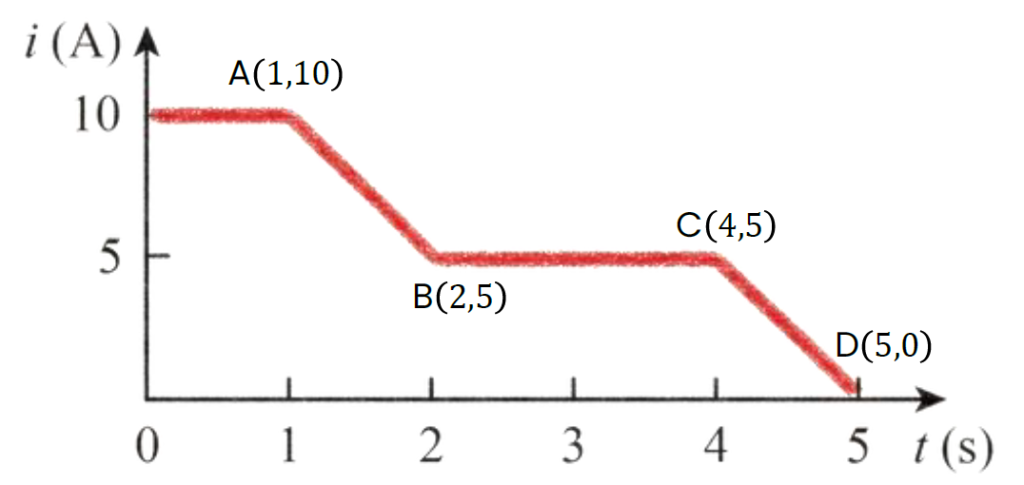
Figure 9 – Circuit diagram for solving the Pb-9
\small \begin{aligned} & (a) \ \ \text{From the Fig. 9,} \\[2ex] & \quad \quad \quad i_1 = 10 \ A \ ; \ 0 < t < 1 \\[2ex] &\quad \quad \quad \therefore Q = \int_0^1 10 \ dt = 10 \ C \\[2ex] & (b) \ \ \text{From the Fig. 9,} \\[2ex] &\quad \quad \quad i_1 = 10 \ A \ ; \ 0 < t < 1 \\[2ex] &\quad \quad \quad i_3 = 5 \ A \ ; \ 2 < t < 3 \\[2ex] &\quad \quad \quad m_{AB} = \frac{y_2-y_1}{x_2-x_1} = \frac{5-10}{2-1} = -5 \\[2ex] &\quad \quad \quad eq^n_{AB} : y - y_1 = m(x - x_1) \\[2ex] &\quad \quad \quad\quad\quad \ \ \Rightarrow y - 10 = -5(x - 1) \\[2ex] &\quad \quad \quad\quad\quad \ \ \Rightarrow y - 10 = -5x + 5 \\[2ex] &\quad \quad \quad\quad\quad \ \ \Rightarrow y = -5x + 15 \\[2ex] & \quad \quad \quad \therefore i_2(t) = (-5t + 15) \ A \ ; \ 1 < t < 2 \\[2.5ex] &\quad \therefore Q = \int_0^1 10 \ dt + \int_1^2 (-5t + 15) \ dt + \int_2^3 5 \ dt \\ &\quad \phantom{\therefore Q} = 22.5 \ C \end{aligned}
\small \begin{aligned} & (c) \ \ \text{From the Fig. 9,} \\[2ex] &\quad \quad \quad i_1 = 10 \ A \ ; \ 0 < t < 1 \\[2ex] &\quad \quad \quad i_2 = (-5t + 15) \ A \ ; \ 1 < t < 2 \\[2ex] &\quad \quad \quad i_3 = 5 \ A \ ; \ 2 < t < 4 \\[2ex] &\quad \quad \quad m_{CD} = \frac{y_2-y_1}{x_2-x_1} = \frac{0-5}{5-4} = -5 \\[2ex] &\quad\quad\quad eq^n_{CD} : y - y_1 = m(x - x_1) \\[2ex] &\quad\quad\quad\quad\quad \ \ \Rightarrow y - 5 = -5(x - 4) \\[2ex] &\quad\quad\quad\quad\quad \ \ \Rightarrow y - 5 = -5x + 20 \\[2ex] &\quad\quad\quad\quad\quad \ \ \Rightarrow y = -5x + 25 \\[2ex] & \quad \quad \quad \therefore i_4(t) = (-5t + 25) \ A \ ; \ 4 < t < 5 \\[2.5ex] &\therefore Q = \int_0^1 10 \ dt + \int_1^2 (-5t + 15) \ dt + \int_2^4 5 \ dt + \int_4^5 (-5t + 25) \ dt \\[2ex] & \phantom{\therefore Q} = 30 \ C \end{aligned}
Solved Problems on Voltage, Power and Energy
Voltage represents the energy required to move a unit charge through an element (v = \frac{dw}{dq}) , while power is the instantaneous rate at which that energy is expanded or absorbed (p = vi) .
The problems below will test your ability to calculate the work required to move charges between potential differences, apply the passive sign convention to determine whether an element is absorbing or supplying power, and evaluate time-dependent power equations to find the total energy consumed over a specific interval.
Problem 10
Pb-10: A lighting bolt with 10 \ kA strikes an object for 15 \ \mu s . How much charge is deposited on the object?
Solution:
\small \begin{aligned} q = it = 10 \times 10^3 \times 15 \times 10^{-6} = 0.15 \ C \end{aligned}
Problem 11
Pb-11: A rechargeable flashlight battery is capable of delivering 90 \ mA for about 12 \ h . How much charge can it release at that rate? If its terminal voltage is 1.5 \ V , how much energy can the battery deliver?
Solution:
\small \begin{aligned} &q = it = 90 \times 10^{-3} \times 12 \times 60 \times 60 = 3888 \ C \\[2.5ex] &v = \frac{w}{q} \Rightarrow w = v \times q = 1.5 \times 3888 = 5832 \ J \end{aligned}
Problem 12
Pb-12: If the current flowing through an element is given by
\small \begin{aligned} i(t) = \left\{ \begin{aligned} 3t \ A, &\quad 0 \le t < 6 \ s \\ 18 \ A, &\quad 6 \le t < 10 \ s \\ -12 \ A, &\quad 10 \le t < 15 \ s \\ 0, &\quad t \ge 15 \ s \end{aligned} \right. \end{aligned}
Plot the charge stored in the element over
\small \begin{aligned} 0 < t < 20 \ s \end{aligned}
Solution:
\small \begin{aligned} \text{Given,} \\[3.5ex] & i(t) = \left\{ \begin{aligned} 3t \ A, &\quad 0 \le t < 6 \ s \\ 18 \ A, &\quad 6 \le t < 10 \ s \\ -12 \ A, &\quad 10 \le t < 15 \ s \\ 0, &\quad t \ge 15 \ s \end{aligned} \right. \end{aligned}
\small \begin{aligned} &\text{Let,} \\[2ex] &\quad \text{The initial charge } [\text{at } t = 0 \ s], \ q(0) = 0 \ C \\[2.5ex] &\text{At } 0 \le t < 6 \ s, \\[2ex] &\quad q(t) = \int_0^t 3t \ dt + q(0) = \left[ \frac{3t^2}{2} \right]_0^t + 0 = \frac{3t^2}{2} \ C \\[2ex] &\quad \text{At the end of the interval } (t = 6 \ s): \\[2ex] &\quad\quad \therefore q(6) = \frac{3 \times 6^2}{2} = 54 \ C \end{aligned}
\small \begin{aligned} &\text{At } 6 \le t < 10 \ s, \\[2ex] &\quad q(t) = \int_6^t 18 \ dt + q(6) = [18t]_6^t + 54 \\[2ex] &\quad \phantom{q(t)} = (18t - 18 \times 6) + 54 \\[2ex] &\quad \phantom{q(t)} = 18t - 108 + 54 \\[2ex] &\quad \phantom{q(t)} = (18t - 54) \ C \\[2ex] &\quad \text{At the end of the interval } (t = 10 \ s): \\[2ex] &\quad\quad \therefore q(10) = (18 \times 10) - 54 = 126 \ C \\[3.5ex] &\text{At } 10 \le t < 15 \ s, \\[2ex] &\quad q(t) = \int_{10}^t -12 \ dt + q(10) = [-12t]_{10}^t + 126 \\[2ex] &\quad \phantom{q(t)} = (-12t + 120) + 126 \\[2ex] &\quad \phantom{q(t)} = (-12t + 246) \ C \\[2ex] &\quad \text{At the end of the interval } (t = 15 \ s): \\[2ex] &\quad\quad \therefore q(15) = (-12 \times 15 + 246) = 66 \ C \\[3.5ex] &\text{At } 15 \le t < 20 \ s, \\[2ex] &\quad q(t) = \int_{15}^t 0 \ dt + q(15) = 0 + 66 = 66 \ C \\[2ex] &\quad \text{At the end of the interval } (t = 20 \ s): \\[2ex] &\quad\quad \therefore q(20) = 66 \ C \end{aligned}
\small \begin{aligned} \therefore q(t) = \left\{ \begin{aligned} \frac{3t^2}{2} \ C &, \quad 0 \le t < 6 \ s \\[2ex] (18t - 54) \ C &, \quad 6 \le t < 10 \ s \\[1.5ex] (-12t + 246) \ C &, \quad 10 \le t < 15 \ s \\[1.5ex] 66 \ C &, \quad t \ge 15 \ s \end{aligned} \right. \end{aligned}
The plot of the charge is shown below:

Figure 10 – Plot of the charge stored in the element
Problem 13
Pb-13: The charge entering the positive terminal of an element is-
q = 5 \sin 4\pi t \ mC
While the voltage across the element (plus to minus) is-
v = 3 \cos 4\pi t \ V
(a) Find the power delivered to the element at t = 0.3 s .
(b) Calculate the energy delivered to the element between 0 and 0.6 \ s .
Solution:
\small \begin{aligned} & (a) \quad i = \frac{dq}{dt} = \frac{d}{dt}(5 \sin 4\pi t) = 5 \cos 4\pi t \cdot 4\pi \\[2ex] &\quad \phantom{(a) i} = 20\pi \cos 4\pi t \ mA \\[2ex] &\quad \phantom{(a) i} = 20\pi \cos 4\pi t \times 10^{-3} \ A \\[2ex] &\quad \phantom{(a)} p = vi = 3 \cos 4\pi t \times 20\pi \cos 4\pi t \times 10^{-3} \\[2ex] &\quad \phantom{(a) p = vi} = 0.06\pi \cos^2 4\pi t \\[2ex] &\quad \phantom{(a) p = vi} = 0.06\pi \cos^2 (4\pi \times 0.3) = 0.1234 \ W \\[3.5ex] &(b) \quad w = \int_{t_0}^t p \ dt = \int_0^{0.6} 0.06\pi \cos^2 4\pi t \ dt \\[2ex] &\quad \phantom{(b) w} = 0.0588 \ J \end{aligned}
Problem 14
Pb-14: The voltage v(t) across a device and the current i(t) through it are:
\small \begin{aligned} v(t) = 10 \cos(2t) \ V \ , \quad i(t) = 20(1 - e^{-0.5t}) \ mA \end{aligned}
(a) The total charge in the device at t = 1 \ s, \ q(0) = 0 .
(b) The power consumed by the device at t = 1 \ s.
Solution:
\small \begin{aligned} & (a) \quad q = \int_{t_0}^t i \ dt + q(0) \\[2ex] &\quad \phantom{(a) q} = \int_0^1 20(1 - e^{-0.5t}) \ dt + 0 \\[2ex] &\quad \phantom{(a) q} = 4.2612 \ mC \\[2.5ex] & (b) \quad p = vi = 10 \cos(2t) \times 0.02(1 - e^{-0.5t}) \\[2ex] &\quad \phantom{(b) p} = 10 \cos(2 \text{ rad}) \times 0.02(1 - e^{-0.5}) \\[2ex] &\quad \phantom{(b) p} = -0.0327 \ W \end{aligned}
Problem 15
Pb-15: The current entering the positive terminal of a device is i(t) = 6e^{-2t} \ mA and the voltage across the device is v(t)=10di/dt \ V
(a) Find the charge delivered to the device between t = 0 and t = 2 \ s .
(b) Calculate the power absorbed.
(c) Determine the energy absorbed when t = 0 and t = 3 \ s .
Solution:
\small \begin{aligned} & (a) \quad Q = \int_{t_0}^t i \ dt = \int_0^2 6e^{-2t} \ dt = 2.95 \ mC \\[3.5ex] & (b) \quad \text{Given,} \\[2ex] & \quad \quad \quad i(t) = 6e^{-2t} \ mA = 0.006e^{-2t} \ A \\[2ex] & \quad \quad \quad v(t) = 10 \frac{di}{dt} = 10 \frac{d}{dt}(0.006e^{-2t}) \\[2ex] &\quad \quad \quad \phantom{v(t)} = 10 \times 0.006 \times e^{-2t} \times (-2) \\[2ex] & \quad \quad \quad \phantom{v(t)} = -0.12e^{-2t} \ V \\[2ex] & \quad \quad \quad \therefore p = vi = (-0.12e^{-2t}) \times (0.006e^{-2t}) \\[2ex] &\quad \quad \quad \quad \ \phantom{p = vi} = -7.2 \times 10^{-4} e^{-4t} \ W \\[3.5ex] &(c) \quad w = \int_{t_0}^t p \ dt = \int_0^3 (-7.2 \times 10^{-4} e^{-4t}) \ dt \\[2ex] &\quad \quad \quad \quad \ \phantom{(c) \quad w} = -1.80 \times 10^{-4} \ J \end{aligned}
Problem 16
Pb-16: Fig. 11 shows the current through and the voltage across an element.
(a) Sketch the power delivered to the element for t > 0 .
(b) Find the total energy absorbed by the element for the period of 0 < t < 4 \ s .

Figure 11 – Circuit diagram for Pb-16
Solution:

Figure 12 – Circuit diagram for solving the Pb-16
\small \begin{aligned} & (a) \ \ \text{From the Fig. 12,} \\[2ex] & \quad \quad \quad m_{AB} = \frac{y_2-y_1}{x_2-x_1} = \frac{60-0}{2-0} = 30 \\[2ex] & \quad \quad \quad eq^n_{AB} : y - y_1 = m(x - x_1) \\[2ex] & \quad \quad \quad \quad \quad \ \ \Rightarrow y - 0 = 30(x - 0) \\[2ex] & \quad \quad \quad \quad \quad \ \ \Rightarrow y = 30x \\[2ex] & \quad \quad \quad \therefore i_1(t) = 30t \ mA \ ; \ 0 < t < 2 \ s \\[2ex] & \quad \quad \quad m_{BC} = \frac{y_2-y_1}{x_2-x_1} = \frac{0-60}{4-2} = -30 \\[2ex] & \quad \quad \quad eq^n_{BC} : y - y_1 = m(x - x_1) \\[2ex] & \quad \quad \quad \quad \quad \ \ \Rightarrow y - 60 = -30(x - 2) \\[2ex] & \quad \quad \quad \quad \quad \ \ \Rightarrow y - 60 = -30x + 60 \\[2ex] & \quad \quad \quad \quad \quad \ \ \Rightarrow y = -30x + 120 \\[2ex] & \quad \quad \quad \therefore i_2(t) = (-30t + 120) \ mA \ ; \ 2 < t < 4 \ s \end{aligned}
\small \begin{aligned} \quad \quad \therefore i(t) = \left\{ \begin{aligned} 30t \ mA , &\quad 0 < t < 2 \ s \\ (-30t + 120) \ mA , &\quad 2 < t < 4 \ s \end{aligned} \right. \end{aligned}
\small \begin{aligned} & \quad \quad \text{From the Fig. 11,} \\[2ex] & \quad \quad \quad v(t) = \left\{ \begin{aligned} 5 \ V , &\quad 0 < t < 2 \ s \\ -5 \ V , &\quad 2 < t < 4 \ s \end{aligned} \right. \end{aligned}
\small \begin{aligned} \quad \quad \therefore p(t) = \left\{ \begin{aligned} 150t \ mW , &\quad 0 < t < 2 \ s \\ (150t - 600) \ mW , &\quad 2 < t < 4 \ s \end{aligned} \right. \end{aligned}
\small \begin{aligned} & \quad \quad \text{At } t = 0 \ s : \\[2ex] & \quad \quad \quad p(t) = 150t \ \therefore p(0) = 0 \ mW \\[2ex] & \quad \quad \text{At } t = 2 \ s : \\[2ex] & \quad \quad \quad \text{From the left-hand side } 0 < t < 2 \ s : \\[2ex] & \quad \quad \quad \quad p(t) = 150t \\[2ex] &\quad \quad \quad \quad \therefore p(2^-) = 150 \times 2 = 300 \ mW \\[2ex] & \quad \quad \quad \text{From the right-hand side } 2 < t < 4 \ s : \\[2ex] &\quad \quad \quad \quad p(t) = 150t - 600 \\[2ex] & \quad \quad \quad \quad \therefore p(2^+) = 150 \times 2 - 600 = -300 \ mW \\[2ex] & \quad \quad \quad \because p(2^-) \neq p(2^+), \ \\[2ex] & \quad \quad \quad \therefore p(t) \text{ is discontinuous at } t = 2 \ s. \\[2ex] & \quad \quad \text{At } t = 4 \ s : \\[2ex] & \quad \quad \quad p(t) = 150t - 600 \\[2ex] & \quad \quad \quad \therefore p(4) = 150 \times 4 - 600 = 0 \ mW \end{aligned}
\quad \ \ \ The power p(t) is sketched below:

Figure 13 – Sketch of the power delivered to the element
\small \begin{aligned} & (b) \ \ \text{From `a'} \\[2ex] &\quad \quad \quad p(t) = \left\{ \begin{aligned} 150t \ mW , &\quad 0 < t < 2 \ s \\ (150t - 600) \ mW , &\quad 2 < t < 4 \ s \end{aligned} \right. \\[4ex] & \quad \quad \quad w = \int_0^4 p(t) \ dt \\[2ex] & \quad \quad \quad \phantom{w} = \int_0^2 150t \ dt + \int_2^4 (150t - 600) \ dt \\[2ex] & \quad \quad \quad \phantom{w} = 0 \ J \end{aligned}
Solved Problems on Circuit Elements
Circuit components are broadly classified as either active elements (capable of generating energy, like batteries and generators) or passive elements (which absorb or store energy, like resistors).
The problems below will test your ability to differentiate between active and passive components, calculate the specific voltage and current values controlled by dependent sources, and verify the law of conservation of energy.
Problem 17
Pb-17: Fig. 14 shows a circuit with five elements. If p_{1} = -205 \ W, \ p_{2} = 60 \ W, \ p_{4} = 45 \ W and p_{5} = 30 \ W . Calculate the power p_{3} absorbed by element 3 .

Figure 14 – Circuit diagram for Pb-17
Solution:
\small \begin{aligned} &\sum p = 0 \\[2ex] & \Rightarrow p_1 + p_2 + p_3 + p_4 + p_5 = 0 \\[2ex] & \Rightarrow -205 + 60 + p_3 + 45 + 30 = 0 \\[2ex] &\therefore p_3 = 70 \ W \end{aligned}
Problem 18
Pb-18: Find the power absorbed by each of the element in the Fig. 15.

Figure 15 – Circuit diagram for Pb-18
Solution:
\small \begin{aligned} & p_1 = 30 \times (-10) = -300 \ W \\[2ex] &p_2 = 10 \times (10) = 100 \ W \\[2ex] &p_3 = 20 \times (14) = 280 \ W \\[2ex] &p_4 = 8 \times (-4) = -32 \ W \\[2ex] &p_5 = 12 \times (-0.4I) = 12 \times \{(-0.4) \times 10\} \\[2ex] & \phantom{p_5} = -48 \ W \end{aligned}
Problem 19
Pb-19: Find i and the power absorbed by each element in the network of Fig. 16.

Figure 16 – Circuit diagram for Pb-19
Solution:

Figure 17 – Circuit diagram for solving the Pb-19
\small \begin{aligned} &i = (8 - 2) = 6 \ A \\[2ex] &p_1 = 9 \times (-8) = -72 \ W \\[2ex] &p_2 = 9 \times (2) = 18 \ W \\[2ex] &p_3 = 3 \times (6) = 18 \ W \\[2ex] &p_4 = 6 \times (6) = 36 \ W \end{aligned}
Problem 20
Pb-20: Find V_0 and the power absorbed by each element in the circuit of Fig. 18.
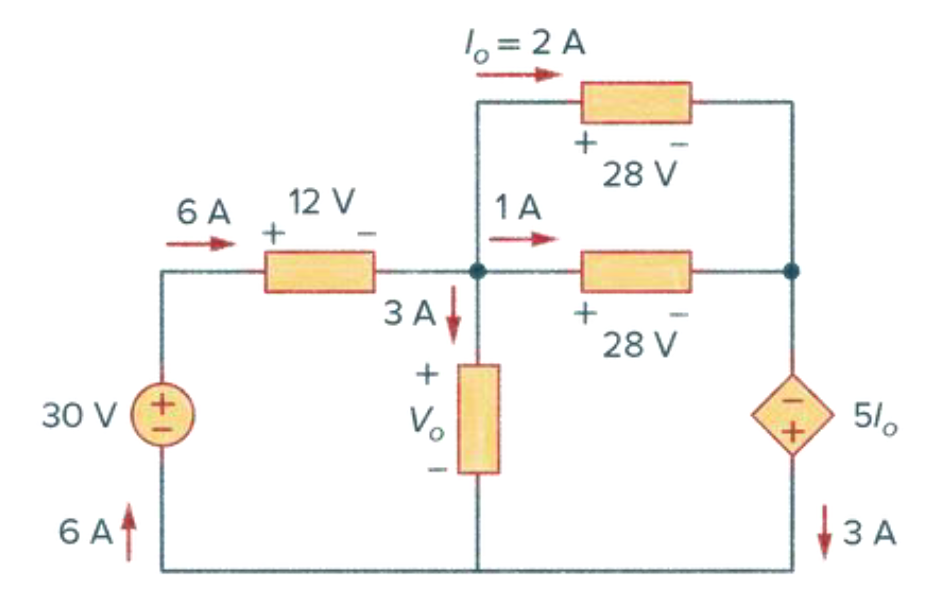
Figure 18 – Circuit diagram for Pb-20
Solution:

Figure 19 – Circuit diagram for solving the Pb-20
\small \begin{aligned} &p_1 = 30 \times (-6) = -180 \ W \\[2ex] &p_2 = 12 \times (6) = 72 \ W \\[2ex] &p_4 = 28 \times (2) = 56 \ W \\[2ex] &p_5 = 28 \times (1) = 28 \ W \\[2ex] &p_6 = 5I_0 \times (-3) = 5 \times 2 \times (-3) = -30 \ W \\[2ex] &\sum p = 0 \\[2ex] &\Rightarrow -180 + 72 + \{V_0 \times (3)\} + 56 + 28 - 30 = 0 \\[2ex] &\therefore V_0 = 18 \ V \\[2ex] &\therefore p_3 = 18 \times (3) = 54 \ W \end{aligned}
Congratulations on working through these numerical problems on the basic concepts of electrical circuits! By conquering these practical examples, you have taken a massive step toward building the strong mathematical foundation required for advanced analytical techniques like nodal and mesh analysis.
Read Also: Basic Laws of Electrical Circuits