

Mastering Circuits!
Mastering the Energy Storage Elements in Electrical Circuits.
Capacitors
A capacitor is a passive element designed to store energy in its electric field.
A capacitor consists of two conducting plates separated by an insulator (or dielectric).

Figure 1 – A typical capacitor
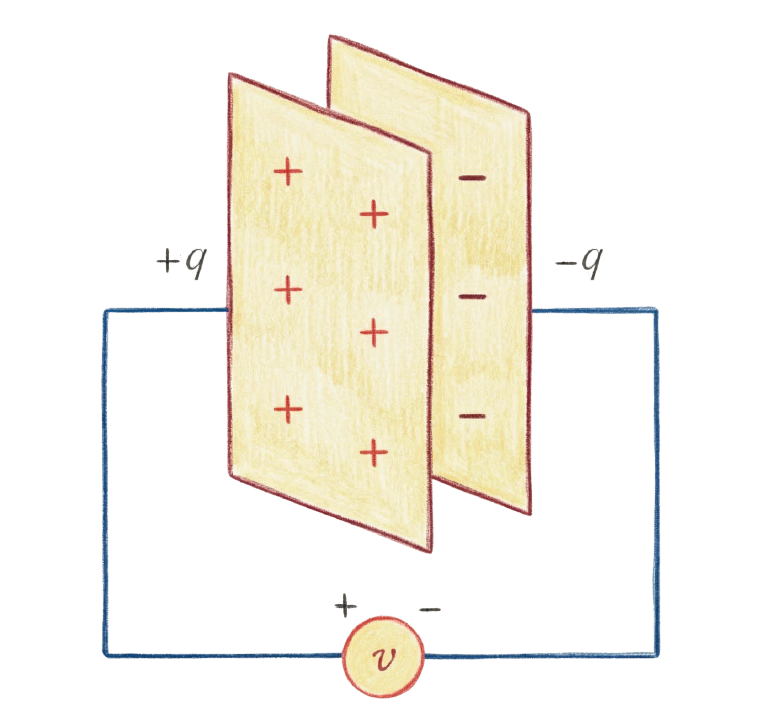
Figure 2 – A capacitor with applied voltage v
When a voltage source v is connected to the capacitor, the source deposits a positive charge q on one plate and a negative charge on the other. The capacitor is said to store the electric charge q .
\small \quad \quad \quad \quad \quad \quad q \propto v \therefore q = Cv \\[2ex] \begin{aligned} &\text{Where,} \\[1ex] & \quad q = \text{electric charge} \\[1ex] & \quad v = \text{voltage} \\[1ex] & \quad C = \text{capacitance of the capacitor} \end{aligned}
Capacitance is the ratio of the charge on one plate of a capacitor to the voltage difference between the two plates, measured in farads (F) .
1 farad = 1 coulomb/volt
\small \begin{aligned} &\text{The capacitance is given by:} \\[2ex] & \quad \quad \quad \quad \quad \quad C = \frac{\epsilon A}{d} \\[2ex] &\text{Where,} \\[1ex] & \quad A = \text{the surface area of each plate} \\[1ex] & \quad d = \text{the distance between the plates} \\[1ex] & \quad \epsilon = \text{the permittivity of dielectric material} \\ & \quad \quad \quad \text{between the plates} \end{aligned}
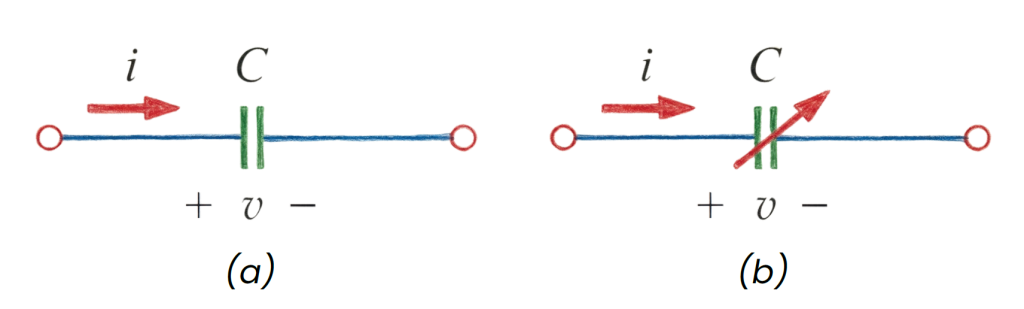
Figure 3 – Circuit symbols for capacitors: (a) fixed capacitor, (b) variable capacitor
- if v>0 and i>0 or if v<0 and i<0 , the capacitor is being charged.
- if v \cdot i<0 , the capacitor is discharging.
Capacitor is used to block DC, pass AC
\small \begin{aligned} &\text{We know,} \\[2ex] & \quad i = \frac{dq}{dt} \\[2ex] & \quad \Rightarrow i = \frac{d}{dt}(Cv) \quad [\because q = Cv] \\[2.5ex] & \quad \Rightarrow \boxed{i = C \frac{dv}{dt}} \\[2.5ex] & \quad \Rightarrow dv = \frac{i}{C} dt \\[2ex] & \quad \Rightarrow \int dv = \int \frac{i}{C} dt \\[2.5ex] & \quad \Rightarrow v(t) = \frac{1}{C} \int i(t) dt \\[2.5ex] & \quad \therefore \boxed{v(t) = \frac{1}{C} \int_{t_0}^{t} i(t) dt + v(t_0)} \\[3.5ex] &\text{Where,} \\[1ex] & \quad \quad t_0 = \text{initial time} \\[1ex] & \quad \quad t = \text{final time} \\[1ex] & \quad \quad v(t_0) = \text{initial voltage} \end{aligned}
\small \begin{aligned} &\text{We know,} \\[2ex] & \quad p = vi \\[2ex] & \quad \Rightarrow p = v \times C \frac{dv}{dt} \quad [\because i = C \frac{dv}{dt}] \\[2ex] & \quad \therefore \boxed{p = Cv \frac{dv}{dt}} \\[4ex] &\text{We know,} \\[2ex] & \quad w = \int p \, dt \\[2ex] & \quad \Rightarrow w = \int Cv \frac{dv}{dt} \, dt \\[2ex] & \quad \Rightarrow w = \int Cv \, dv = C \int v \, dv \\[2ex] & \quad \Rightarrow w = C \frac{v^2}{2} \\[2ex] & \quad \therefore \boxed{w = \frac{1}{2} Cv^2} \\[2ex] & \quad \Rightarrow w = \frac{1}{2} C \times \left( \frac{q}{C} \right)^2 \quad [\because q = Cv \therefore v = \frac{q}{C}] \\[2ex] & \quad \therefore \boxed{w = \frac{q^2}{2C}} \end{aligned}
\scriptsize \boxed{ \begin{aligned} &\text{The current through a capacitor: } i = C \frac{dv}{dt} \\[2.5ex] &\text{The voltage across a capacitor: } v(t) = \frac{1}{C} \int_{t_0}^{t} i(t)dt + v(t_0) \\[2.5ex] &\text{The power delivered to a capacitor: } p = Cv \frac{dv}{dt} \\[2.5ex] &\text{The energy stored in a capacitor: } w = \frac{1}{2}Cv^2 = \frac{q^2}{2C} \end{aligned} }
Prove that A capacitor is an open circuit to DC.
Proof:
\small \begin{aligned} &\text{For a capacitor,} \\[1.5ex] & \quad \quad \quad \quad \quad \quad i = C \frac{dv}{dt} \\[2ex] &\text{Let,} \\[1.5ex] & \quad v = V_{DC} \quad \quad \quad [DC \text{ voltage applied}] \\[2ex] &\text{Now,} \\[1.5ex] & \quad \begin{aligned} & i = C \frac{dV_{DC}}{dt} \\[1.5ex] & \Rightarrow i = C \times 0 \end{aligned} \ \ {\scriptsize \left[ \frac{dV_{DC}}{dt} = 0 \ \because \ \begin{aligned} &\text{DC voltage does not} \\ &\text{change with time} \end{aligned} \right]} \\[2ex] & \quad \therefore i = 0 \\[2ex] &\text{As the current through the capacitor is zero} \\ &\text{when DC voltage is applied, therefore a} \\ &\text{capacitor is an open circuit to DC. \quad \textbf{[Proved]}} \end{aligned}