
Mastering Circuits!
Comfortable reducing electrical networks with series and parallel combinations? Good! This post takes that same idea further. This post provides some Questions Solution of Series and Parallel Circuit.
Basic Formula

Figure 1 – n resistors in series
▪️Equivalent Resistance,
\small \begin{aligned} &R_{eq} = R_1 + R_2 + R_3 + \ \text{\text{-} \text{-} \text{-} \text{-}} \ + R_N \end{aligned}

Figure 2 – n inductors in series
▪️Equivalent Inductance,
\small \begin{aligned} &L_{eq} = L_1 + L_2 + L_3 + \ \text{\text{-} \text{-} \text{-} \text{-}} \ + L_N \end{aligned}

Figure 3 – n capacitors in series
▪️Equivalent Capacitance,
\small \begin{aligned} &\frac{1}{C_{eq}} = \frac{1}{C_1} + \frac{1}{C_2} + \frac{1}{C_3} + \ \text{\text{-} \text{-} \text{-} \text{-}} \ + \frac{1}{C_N} \end{aligned}

Figure 4 – n resistors in parallel
▪️Equivalent Resistance,
\small \begin{aligned} &\frac{1}{R_{eq}} = \frac{1}{R_1} + \frac{1}{R_2} + \frac{1}{R_3} + \ \text{\text{-} \text{-} \text{-} \text{-}} \ + \frac{1}{R_N} \end{aligned}

Figure 5 – n inductors in parallel
▪️Equivalent Inductance,
\small \begin{aligned} &\frac{1}{L_{eq}} = \frac{1}{L_1} + \frac{1}{L_2} + \frac{1}{L_3} + \ \text{\text{-} \text{-} \text{-} \text{-}} \ + \frac{1}{L_N} \end{aligned}

Figure 6 – n capacitors in parallel
▪️Equivalent Capacitance,
\small \begin{aligned} &C_{eq} = C_1 + C_2 + C_3 + \ \text{\text{-} \text{-} \text{-} \text{-}} \ + C_N \end{aligned}
Questions Solution
We will solve some problems that put the formulas above to work. Some are straightforward reductions; a few will need you to spot redundant nodes or short-circuited branches before the circuit simplifies at all. Try each one yourself first, the solution is there to check your work, not to read before you’ve attempted it.
Problem 1
Pb-1: Find equivalent resistance between a-b in the following circuit.

Figure 7 – Circuit diagram for Pb-1
Solution:
Simplifying the circuit,
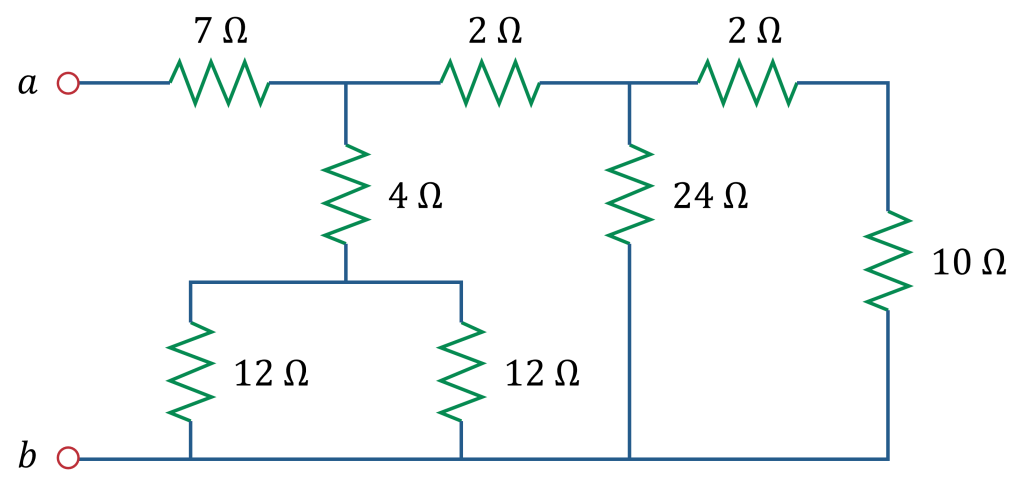
Figure 8 – Circuit diagram for solving the Pb-1
\small \begin{aligned} &R_{ab} = (((((2 + 10)||24) + 2)||((12||12) + 4)) + 7 \\[2ex] & \scriptsize{\Rightarrow R_{ab} = \left(\left(\left((2 + 10)^{-1} + 24^{-1}\right)^{-1} + 2\right)^{-1} + \left((12^{-1} + 12^{-1})^{-1} + 4\right)^{-1}\right)^{-1} + 7} \\[2ex] &\therefore R_{ab} = 12 \ \Omega \end{aligned}
Problem 2
Pb-2: Determine R_{eq} and I in the circuit shown below.
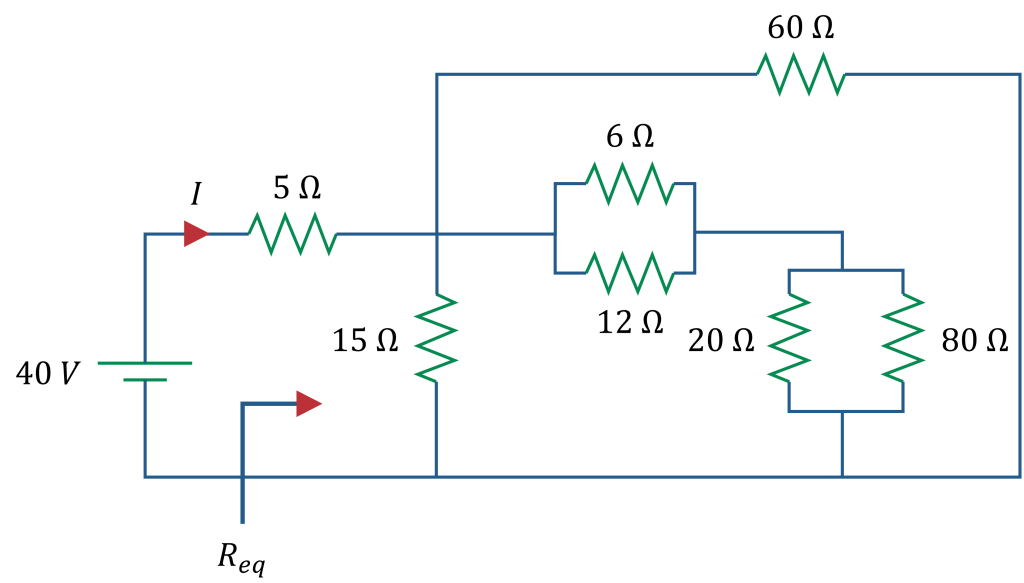
Figure 9 – Circuit diagram for Pb-2
Solution:
\small \begin{aligned} &R_{eq} = (((20||80) + (6||12))||60||15) + 5 \\[2ex] & \scriptsize{\Rightarrow R_{eq} = \left(\left((20^{-1} + 80^{-1})^{-1} + (6^{-1} + 12^{-1})^{-1}\right)^{-1} + 60^{-1} + 15^{-1}\right)^{-1} + 5} \\[2ex] &\therefore R_{eq} = 12.5 \ \Omega \\[2ex] &\therefore I = \frac{40}{R_{eq}} = \frac{40}{12.5} = 3.2 \ A \end{aligned}
Problem 3
Pb-3: Determine R_{eq} in the following circuit.
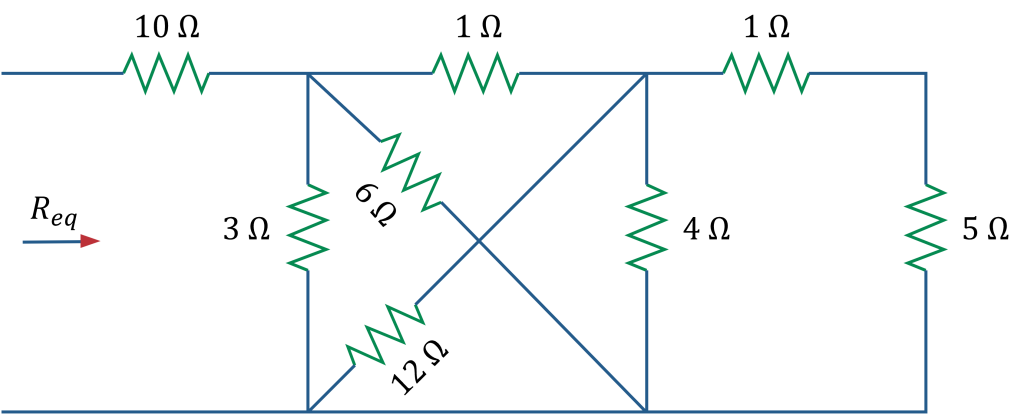
Figure 10 – Circuit diagram for Pb-3
Solution:

Figure 11 – Circuit diagram for solving the Pb-3
The resistors connected between the same nodes, b-b, will be short circuited.
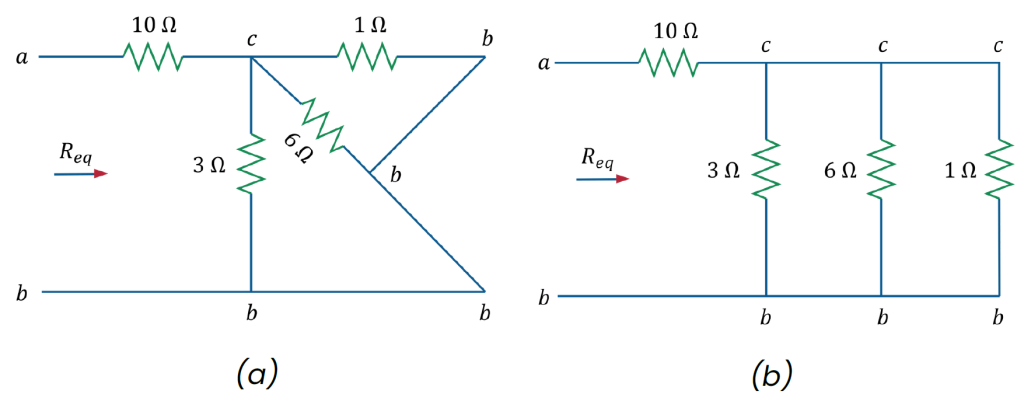
Figure 12 – Circuit diagram for solving the Pb-3 (simplifying the circuit in Fig. 11)
\small \begin{aligned} &R_{eq} = (3||6||1) + 10 \\[2ex] &\Rightarrow R_{eq} = (3^{-1} + 6^{-1} + 1^{-1})^{-1} + 10 \\[2ex] &\therefore R_{eq} = 10.67 \ \Omega \end{aligned}
Problem 4
Pb-4: Find R_{eq} in the circuit shown below.
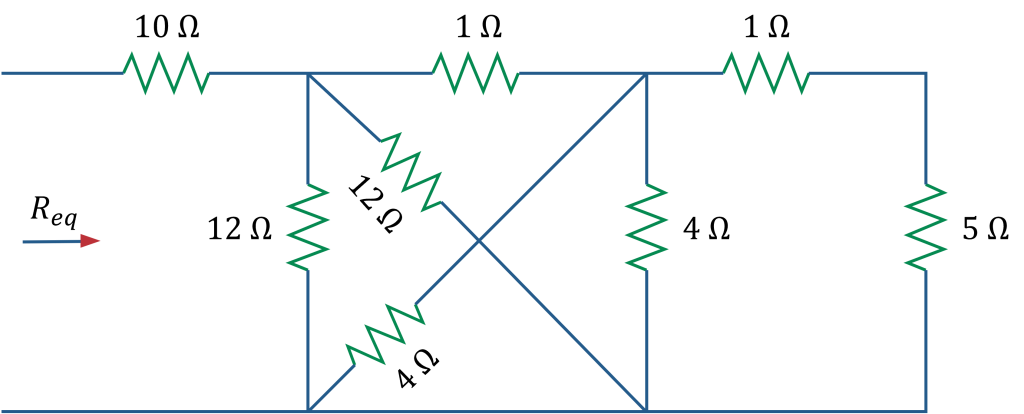
Figure 13 – Circuit diagram for Pb-4
Solution:
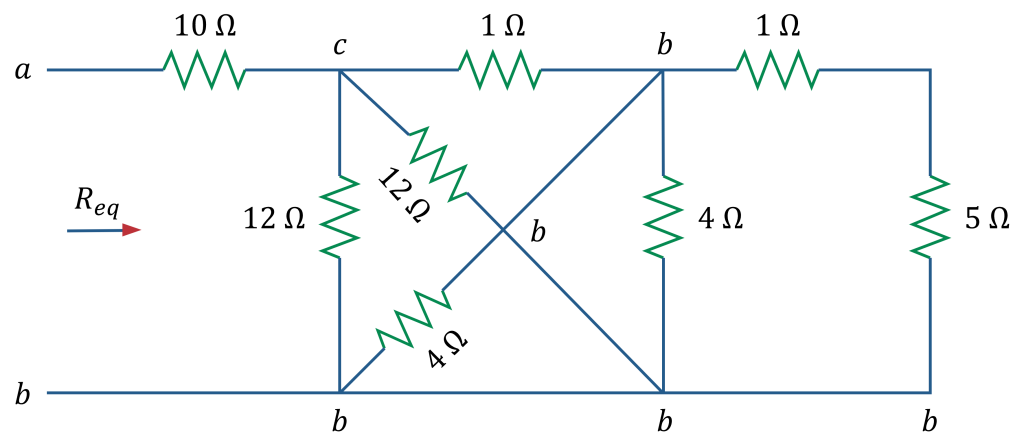
Figure 14 – Circuit diagram for solving the Pb-4
The resistors connected between the same nodes, b-b, will be short circuited.
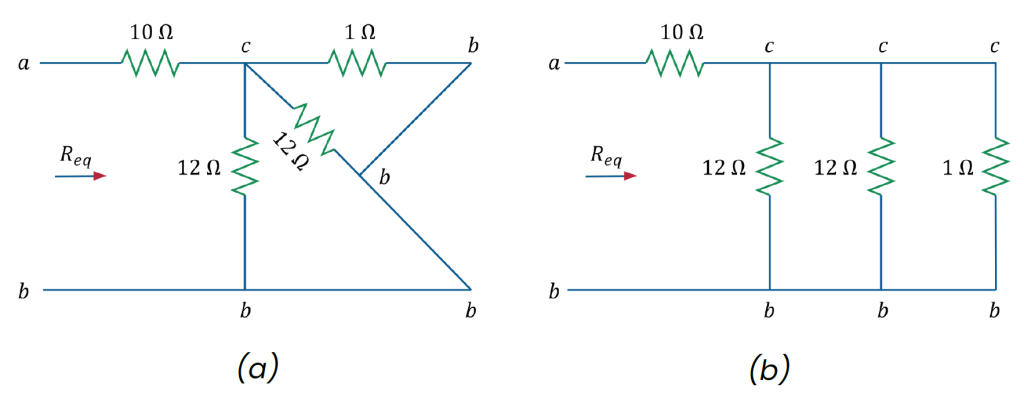
Figure 15 – Circuit diagram for solving the Pb-4 (simplifying the circuit in Fig. 14)
\small \begin{aligned} &R_{eq} = (12||12||1) + 10 \\[2ex] &R_{eq} = (12^{-1} + 12^{-1} + 1^{-1})^{-1} + 10 \\[2ex] &\therefore R_{eq} = 10.86 \ \Omega \end{aligned}
Problem 5
Pb-5: Calculate the equivalent resistance R_{ab} in the circuit of Fig. 16.
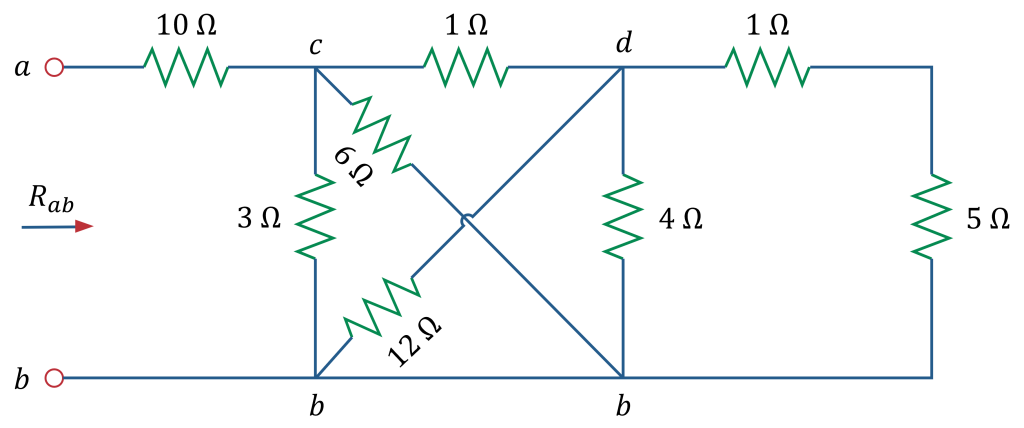
Figure 16 – Circuit diagram for Pb-5
Solution:
\small \begin{aligned} &R_{ab} = (((((5 + 1)||4||12) + 1)||3||6) + 10 \\[2ex] & \scriptsize{\Rightarrow R_{ab} = \left(\left(\left((5 + 1)^{-1} + 4^{-1} + 12^{-1}\right)^{-1} + 1\right)^{-1} + 3^{-1} + 6^{-1}\right)^{-1} + 10} \\[2ex] &\therefore R_{ab} = 11.2 \ \Omega \end{aligned}
Problem 6
Pb-6: Calculate the equivalent resistance R_{ab} in the following circuit.
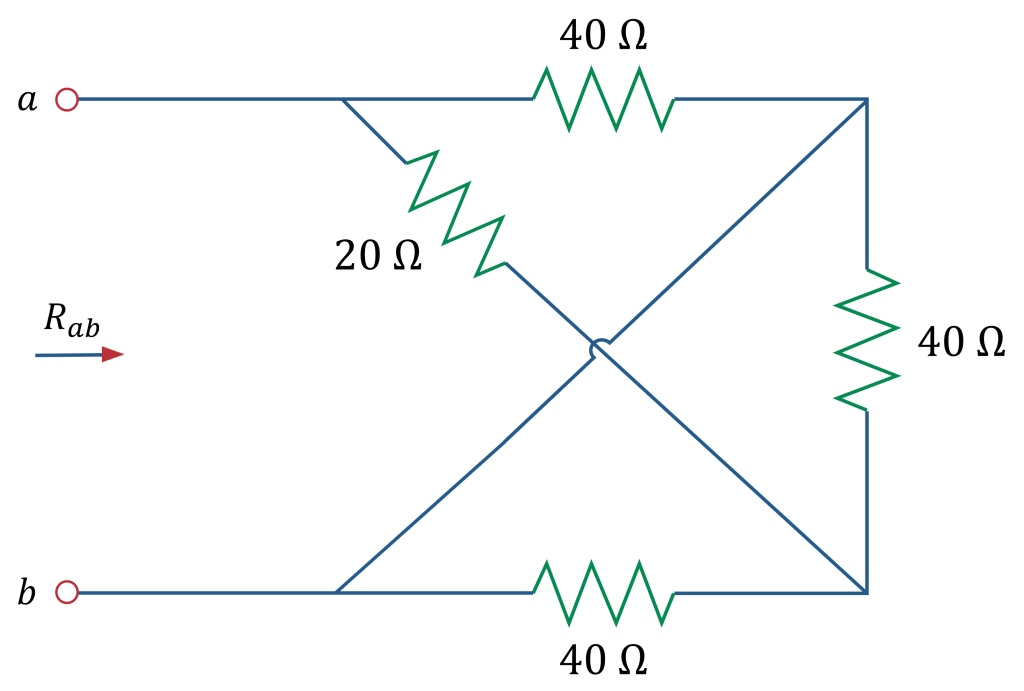
Figure 17 – Circuit diagram for Pb-6
Solution:
\small \begin{aligned} &R_{ab} = (((40||40) + 20)||40) \\[2ex] &\Rightarrow R_{ab} = \left(\left((40^{-1} + 40^{-1})^{-1} + 20\right)^{-1} + 40^{-1}\right)^{-1} \\[2ex] &\therefore R_{ab} = 20 \ \Omega \end{aligned}
Problem 7
Pb-7: For the following circuit, calculate the current I assuming all resistors are 20 \ \Omega .
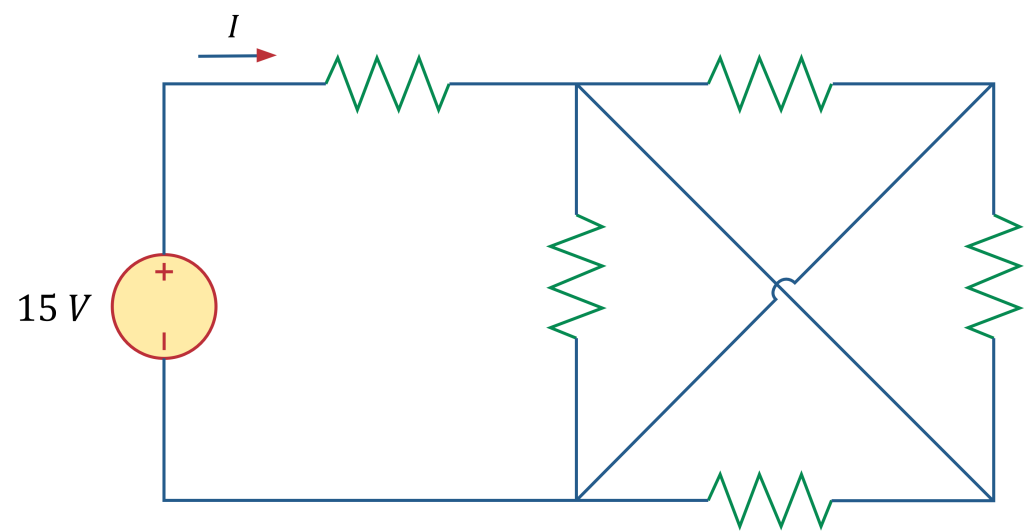
Figure 18 – Circuit diagram for Pb-7
Solution:
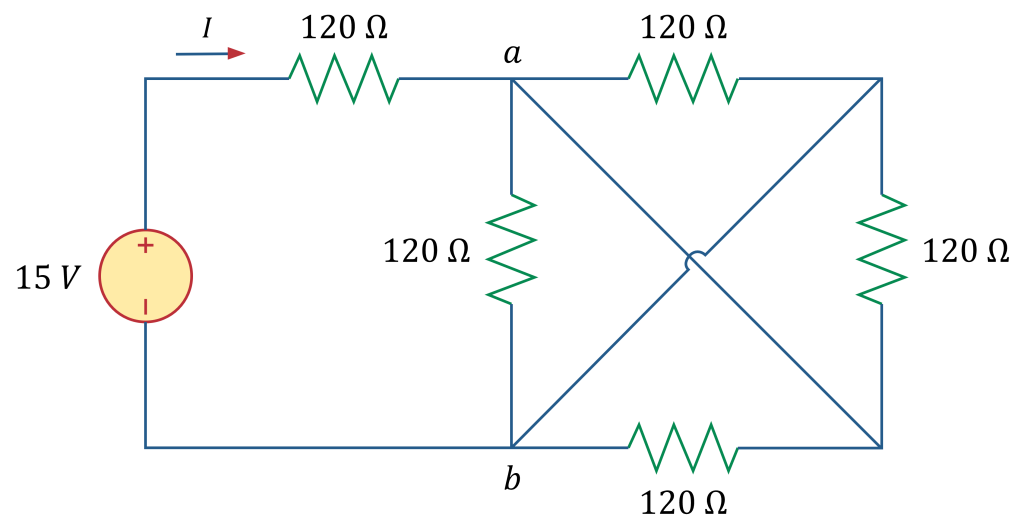
Figure 19 – Circuit diagram for solving the Pb-7
\small \begin{aligned} &R_{eq} = (120||120||120||120) + 120 \\[2ex] &\Rightarrow R_{eq} = (120^{-1} + 120^{-1} + 120^{-1} + 120^{-1})^{-1} + 120 \\[2ex] &\therefore R_{eq} = 150 \ \Omega \\[2ex] &\therefore I = \frac{15}{R_{eq}} = \frac{15}{150} = 0.1 \ A \end{aligned}
Problem 8
Pb-8: Calculate the current I in the following circuit.
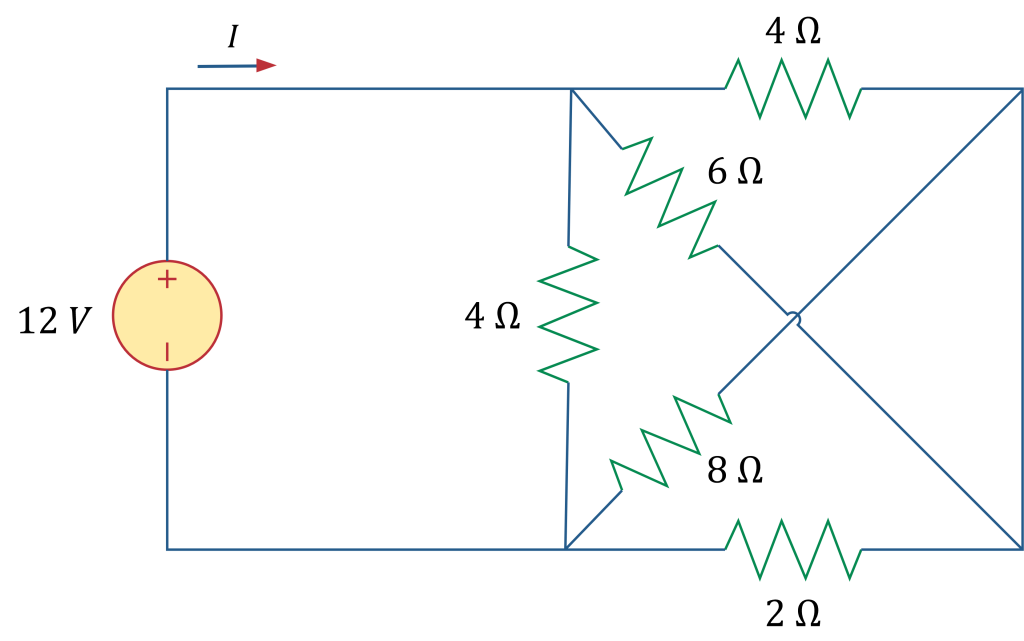
Figure 20 – Circuit diagram for Pb-8
Solution:
\small \begin{aligned} &R_{eq} = (((8||2) + (4||6))||4) \\[2ex] & \scriptsize{\Rightarrow R_{eq} = \left(\left((8^{-1} + 2^{-1})^{-1} + (4^{-1} + 6^{-1})^{-1}\right)^{-1} + 4^{-1}\right)^{-1}} \\[2ex] &\therefore R_{eq} = 2 \ \Omega \\[2ex] &\therefore I = \frac{12}{R_{eq}} = \frac{12}{2} = 6 \ A \end{aligned}
Problem 9
Pb-9: Determine the equivalent resistance between terminals a and b for the circuit shown below.
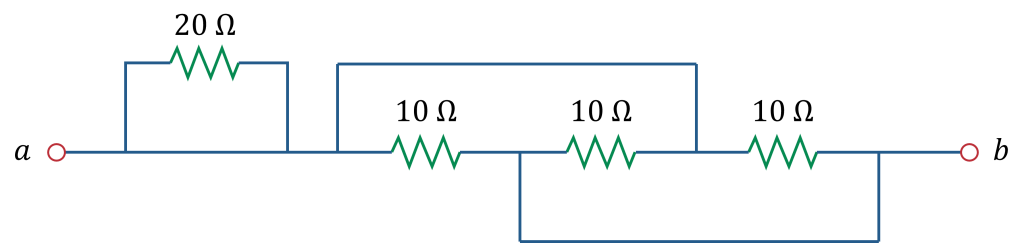
Figure 21 – Circuit diagram for Pb-9
Solution:
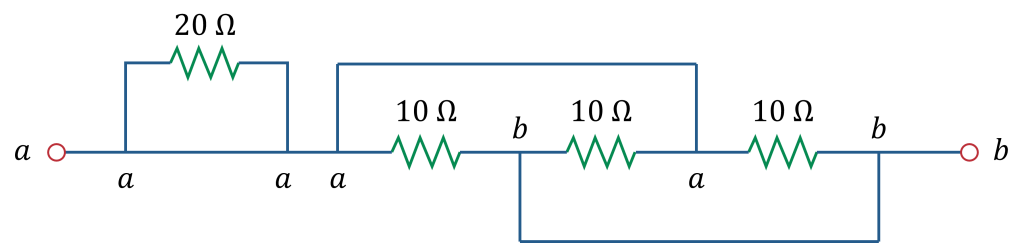
Figure 22 – Circuit diagram for solving the Pb-9
The resistor connected between the same nodes, a-a, will be short circuited.
\small \begin{aligned} &R_{eq} = (10||10||10) \\[2ex] &\Rightarrow R_{eq} = (10^{-1} + 10^{-1} + 10^{-1})^{-1} \\[2ex] &\therefore R_{eq} = 3.33 \ \Omega \end{aligned}
Problem 10
Pb-10: For the following circuit, calculate the equivalent resistance R_{eq} assuming all resistors are 3 \ \Omega .
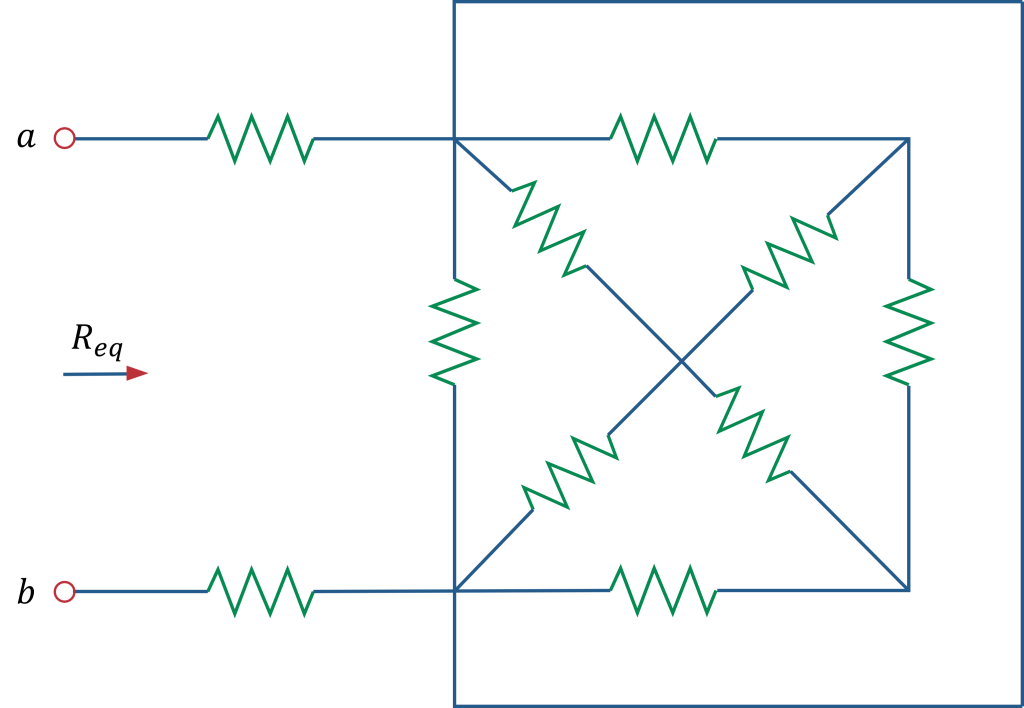
Figure 23 – Circuit diagram for Pb-10
Solution:
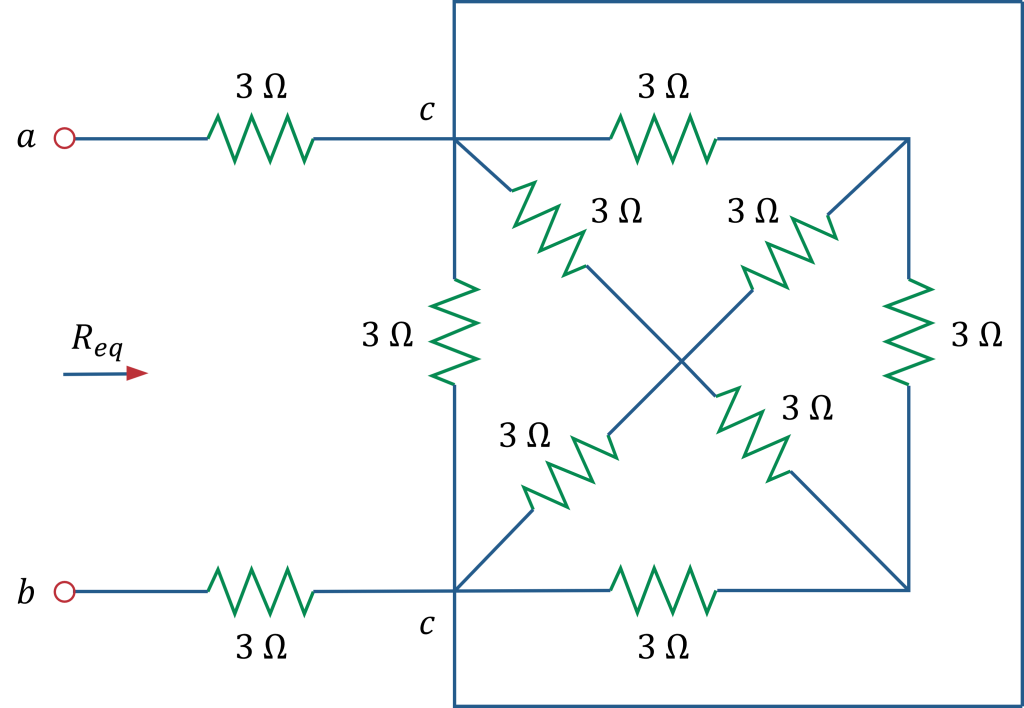
Figure 24 – Circuit diagram for solving the Pb-10
The resistors connected between the same nodes, c-c, will be short circuited.
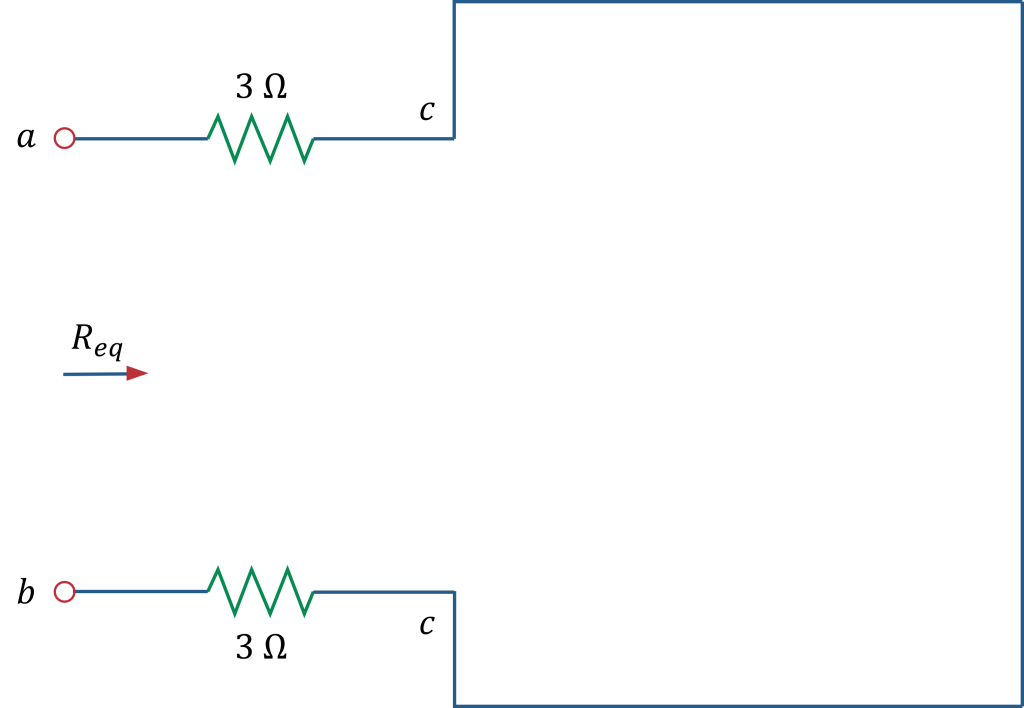
Figure 25 – Circuit diagram for solving the Pb-10 (simplifying the circuit in Fig. 24)
\small \begin{aligned} &R_{eq} = 3 + 3 \\[2ex] &\therefore R_{eq} = 6 \ \Omega \end{aligned}
Problem 11
Pb-11: Find equivalent resistance of the following circuit. The value of each resistance is 15 \ \Omega .
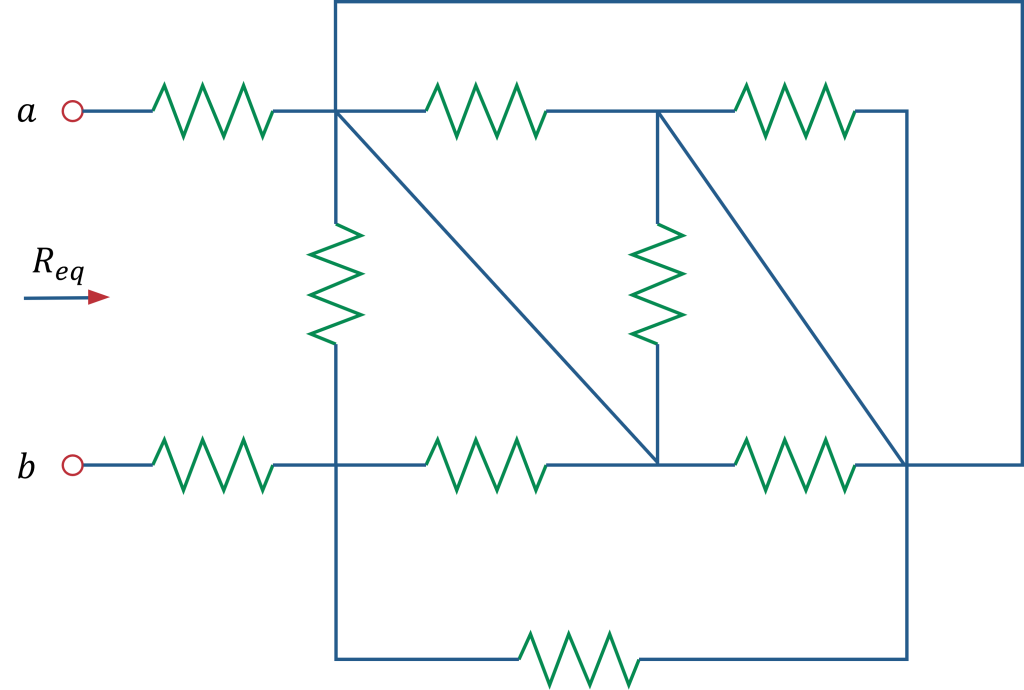
Figure 26 – Circuit diagram for Pb-11
Solution:
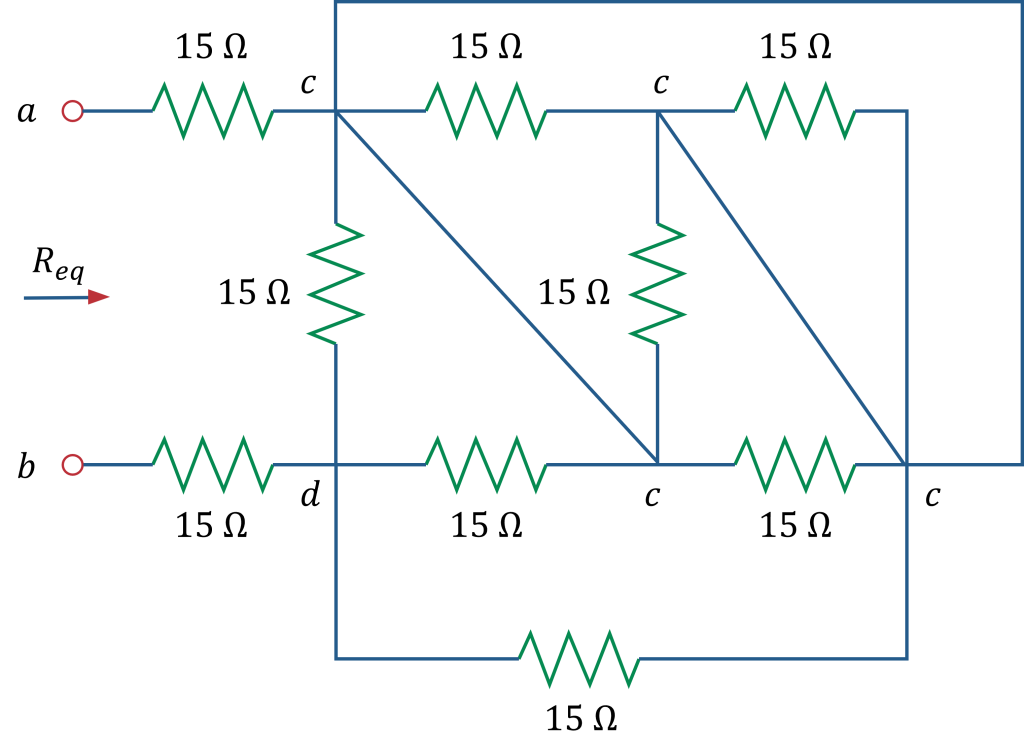
Figure 27 – Circuit diagram for solving the Pb-11
The resistors connected between the same nodes, c-c, will be short circuited.
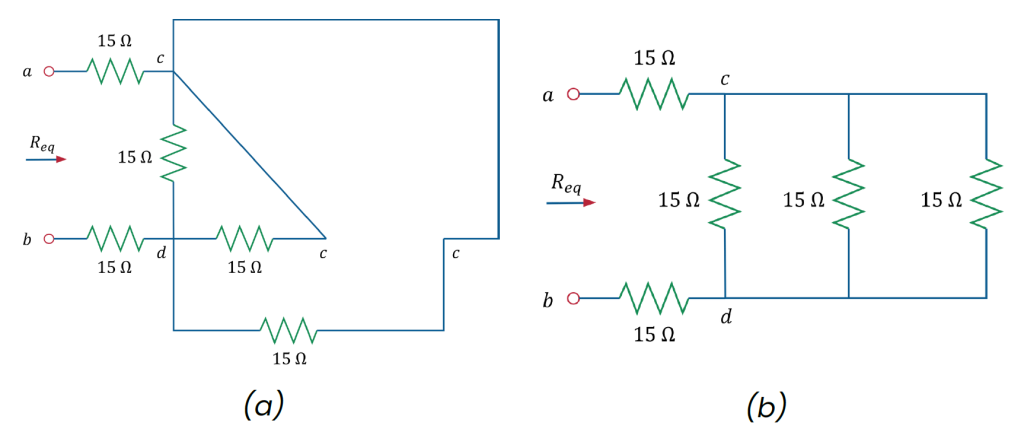
Figure 28 – Circuit diagram for solving the Pb-11 (simplifying the circuit in Fig. 27)
\small \begin{aligned} &R_{eq} = (15||15||15) + 15 + 15 \\[2ex] &\Rightarrow R_{eq} = (15^{-1} + 15^{-1} + 15^{-1})^{-1} + 15 + 15 \\[2ex] &\therefore R_{eq} = 35 \ \Omega \end{aligned}
Problem 12
Pb-12: Find R_{eq} and I_{0} in the circuit of Fig. 29.
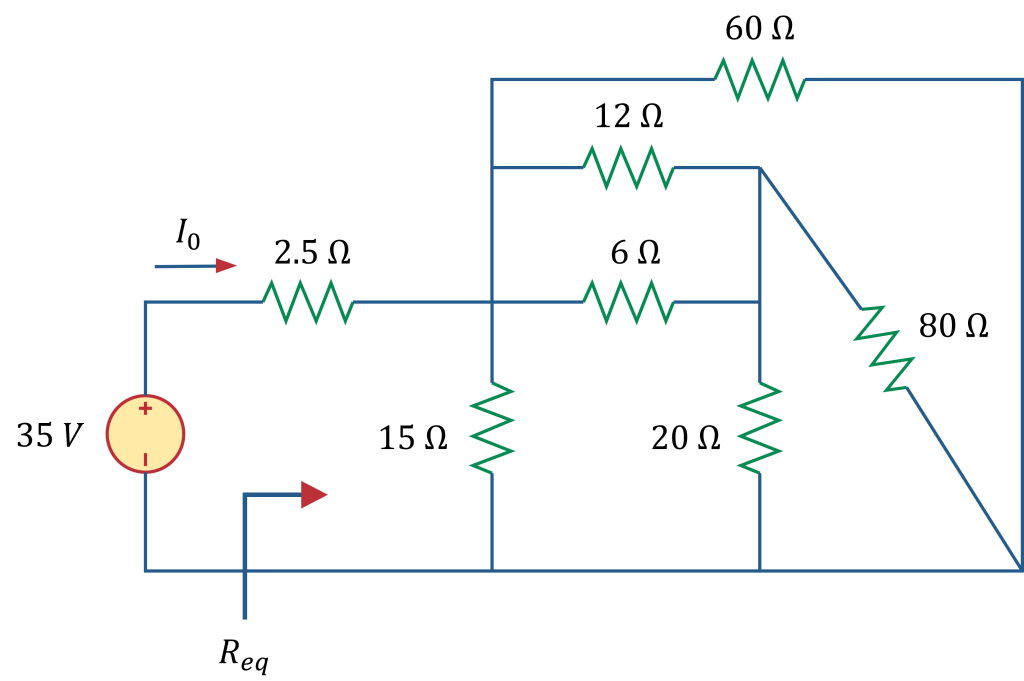
Figure 29 – Circuit diagram for Pb-12
Solution:
\small \begin{aligned} &R_{eq} = (((20||80) + (6||12))||15||60) + 2.5 \\[2ex] & \scriptsize{\Rightarrow R_{eq} = \left(\left((20^{-1} + 80^{-1})^{-1} + (6^{-1} + 12^{-1})^{-1}\right)^{-1} + 15^{-1} + 60^{-1}\right)^{-1} + 2.5} \\[2ex] &\therefore R_{eq} = 10 \ \Omega \\[2ex] &\therefore I_0 = \frac{35}{R_{eq}} = \frac{35}{10} = 3.5 \ A \end{aligned}
Problem 13
Pb-13: Find equivalent resistance of the following circuit.
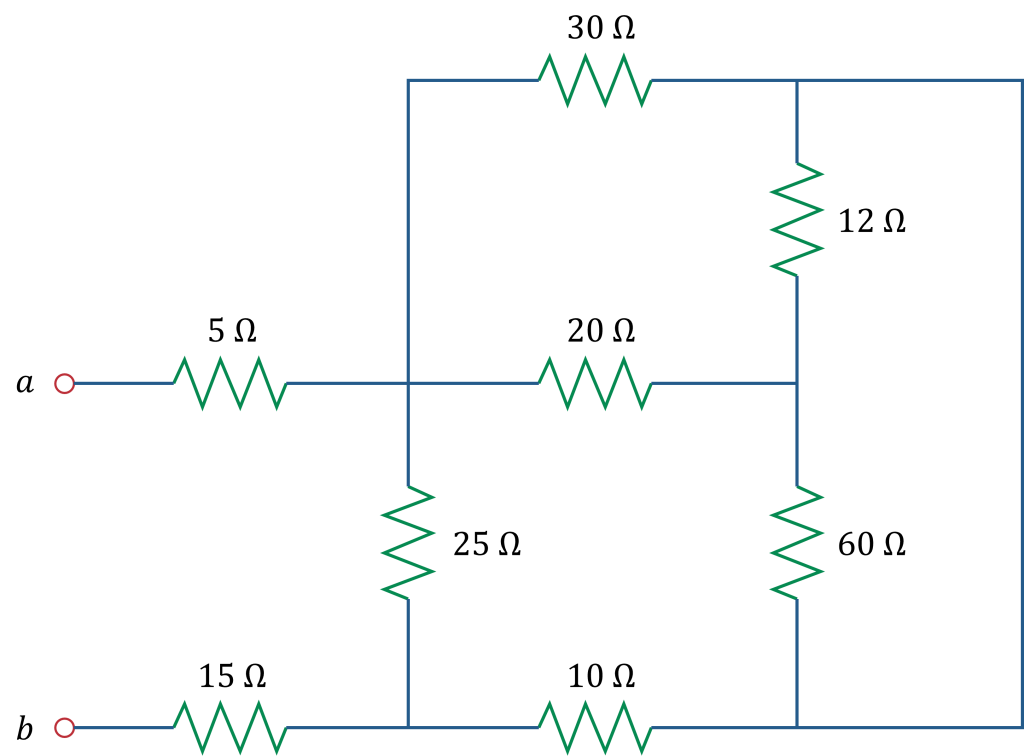
Figure 30 – Circuit diagram for Pb-13
Solution:
\small \begin{aligned} &R_{eq} = (((((12||60) + 20)||30) + 10)||25) + 5 + 15 \\[2ex] & \scriptsize{\Rightarrow R_{eq} = \left(\left(\left(\left((12^{-1} + 60^{-1})^{-1} + 20\right)^{-1} + 30^{-1}\right)^{-1} + 10\right)^{-1} + 25^{-1}\right)^{-1} + 5 + 15} \\[2ex] &\therefore R_{eq} = 32.5 \ \Omega \end{aligned}
Problem 14
Pb-14: Find equivalent resistance R_{ab} of the following circuit.
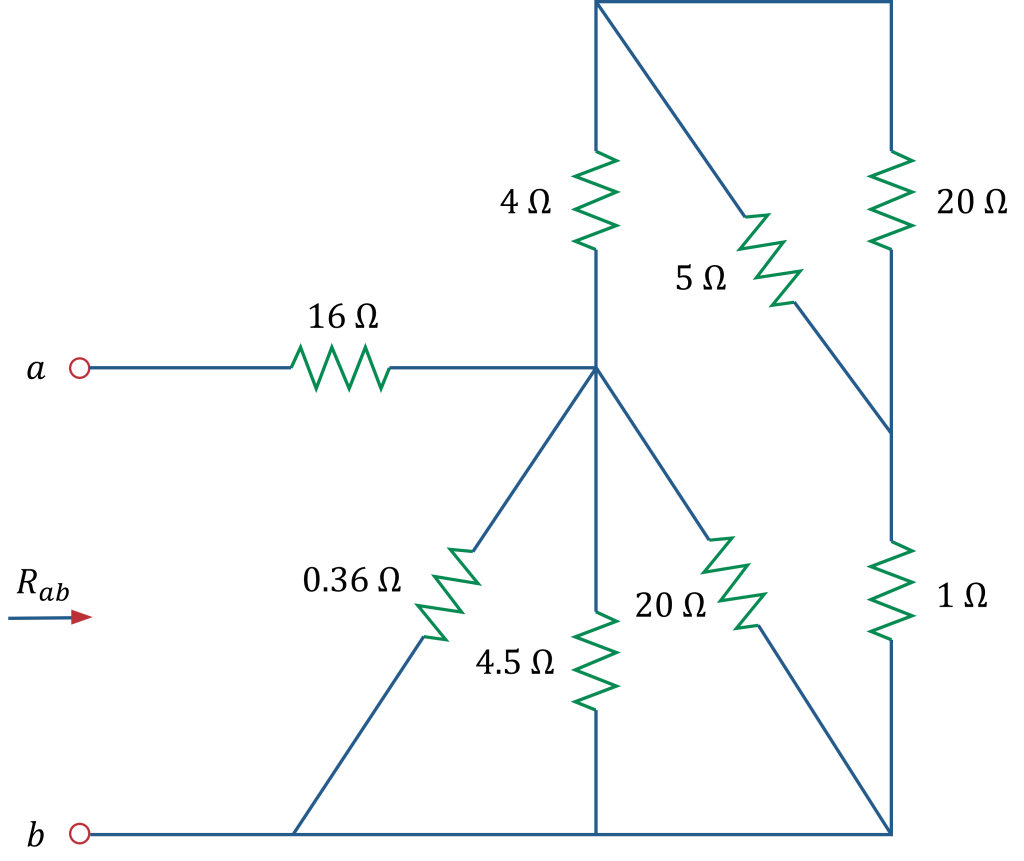
Figure 31 – Circuit diagram for Pb-14
Solution:
\small \begin{aligned} &R_{ab} = ((((20||5) + 4 + 1)||0.36||4.5||20) + 16 \\[2ex] & \scriptsize{\Rightarrow R_{ab} = \left(\left((20^{-1} + 5^{-1})^{-1} + 4 + 1\right)^{-1} + 0.36^{-1} + 4.5^{-1} + 20^{-1}\right)^{-1} + 16} \\[2ex] &\therefore R_{ab} = 16.32 \ \Omega \end{aligned}
Problem 15
Pb-15: Determine the equivalent resistance across terminals a-b for the circuit below.
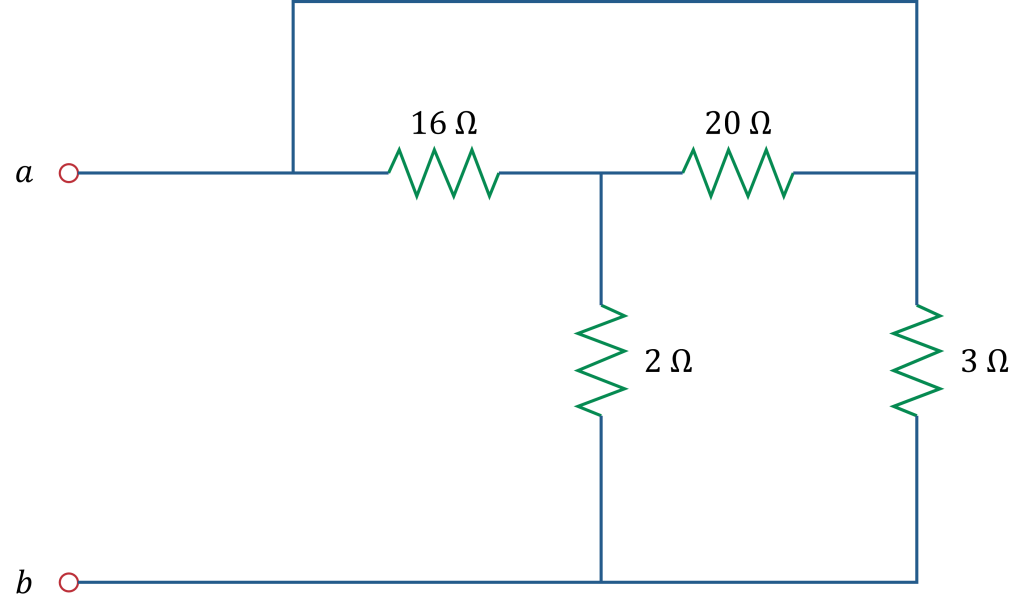
Figure 32 – Circuit diagram for Pb-15
Solution:
\small \begin{aligned} &R_{ab} = (((16||20) + 2)||3) \\[2ex] &\Rightarrow R_{ab} = \left(\left((16^{-1} + 20^{-1})^{-1} + 2\right)^{-1} + 3^{-1}\right)^{-1} \\[2ex] &\therefore R_{ab} = 2.352 \ \Omega \end{aligned}
Problem 16
Pb-16: Obtain the equivalent resistance at terminals a-b:
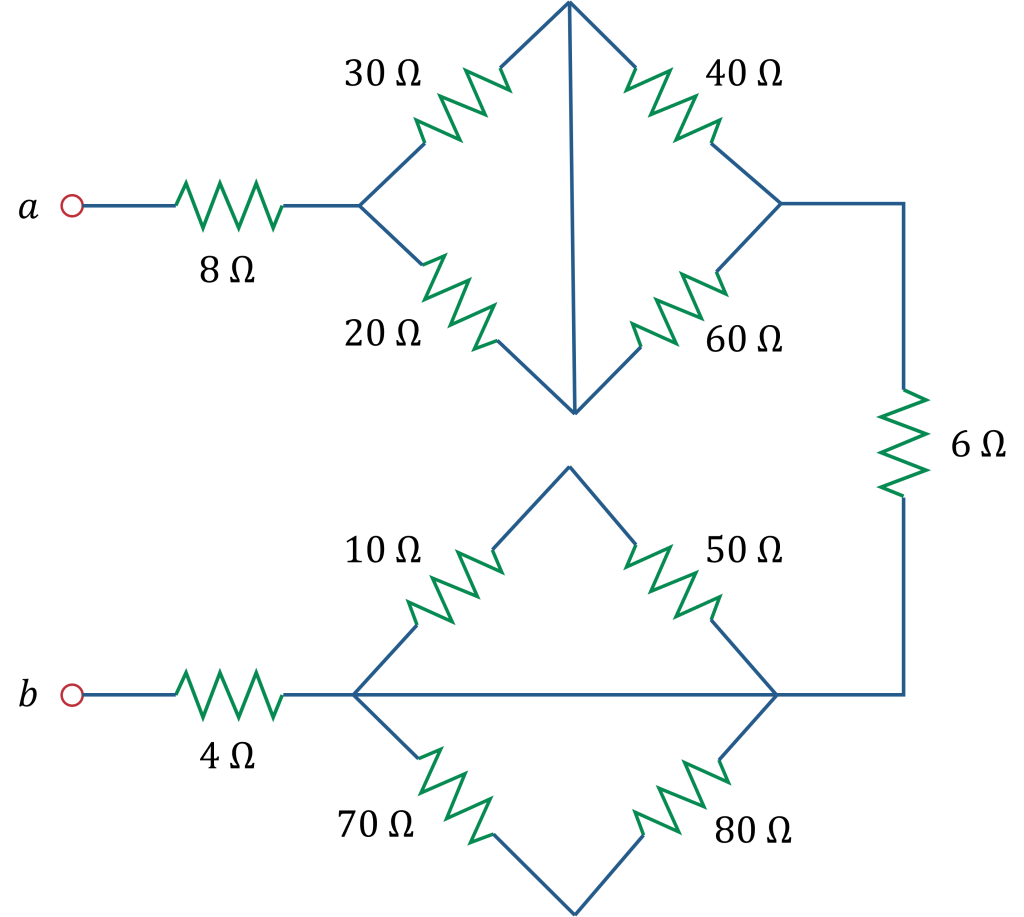
Figure 33 – Circuit diagram for Pb-16
Solution:
Simplifying the circuit,
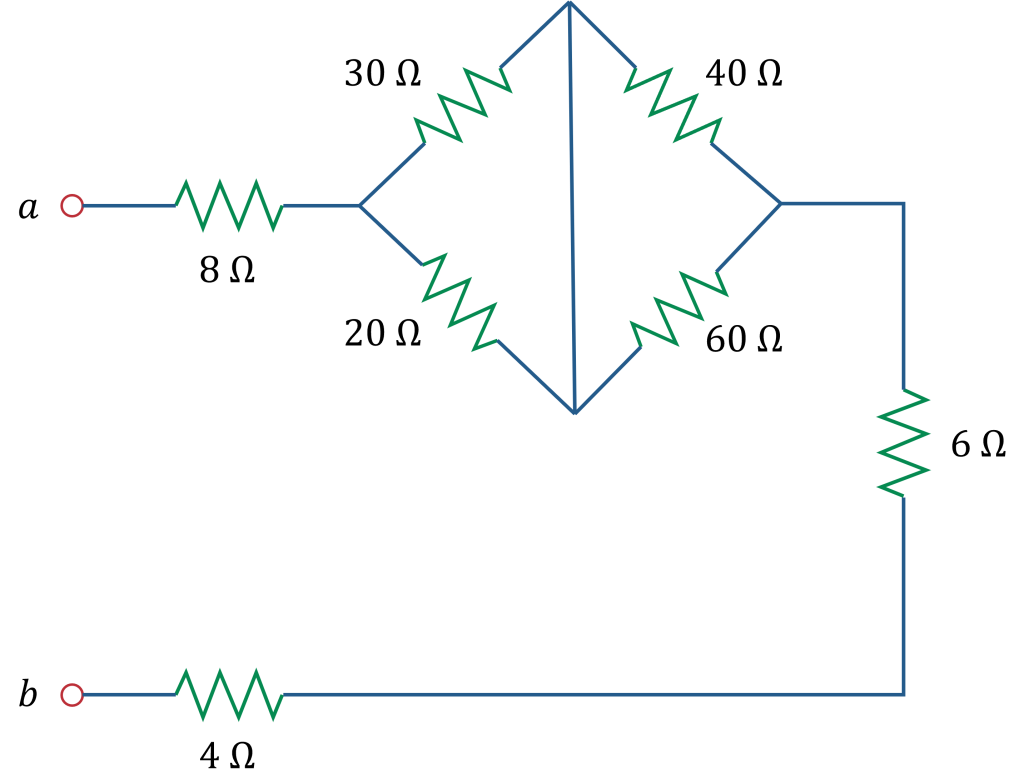
Figure 34 – Circuit diagram for solving the Pb-16
\small \begin{aligned} &R_{ab} = 8 + (30||20) + (40||60) + 6 + 4 \\[2ex] &\Rightarrow R_{ab} = 8 + (30^{-1} + 20^{-1})^{-1} + (40^{-1} + 60^{-1})^{-1} + 6 + 4 \\[2ex] &\therefore R_{ab} = 54 \ \Omega \end{aligned}
Problem 17
Pb-17: Determine I_{s} for the circuit below.
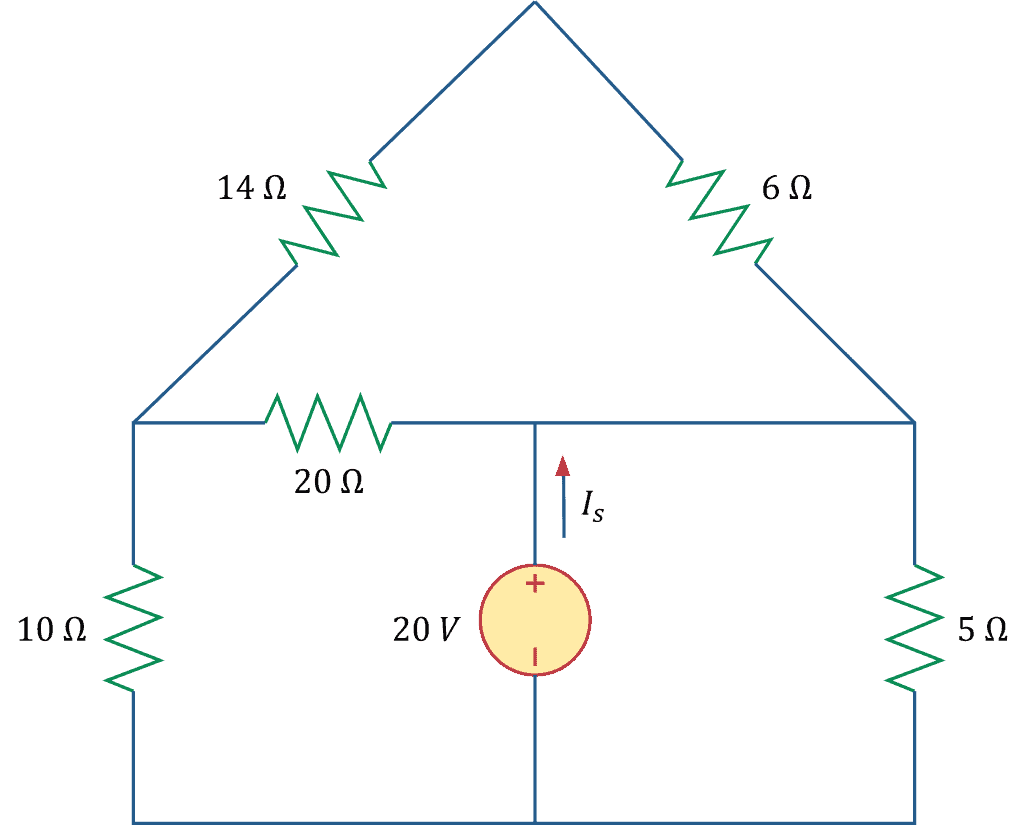
Figure 35 – Circuit diagram for Pb-17
Solution:
\small \begin{aligned} &R_{eq} = ((((14 + 6)||20) + 10)||5) \\[2ex] &\Rightarrow R_{eq} = \left(\left(((14 + 6)^{-1} + 20^{-1})^{-1} + 10\right)^{-1} + 5^{-1}\right)^{-1} \\[2ex] &\therefore R_{eq} = 4 \ \Omega \\[2ex] &\therefore I_s = \frac{20}{R_{eq}} = \frac{20}{4} = 5 \ A \end{aligned}
Problem 18
Pb-18: Find the equivalent resistance between a-b in the following circuit.
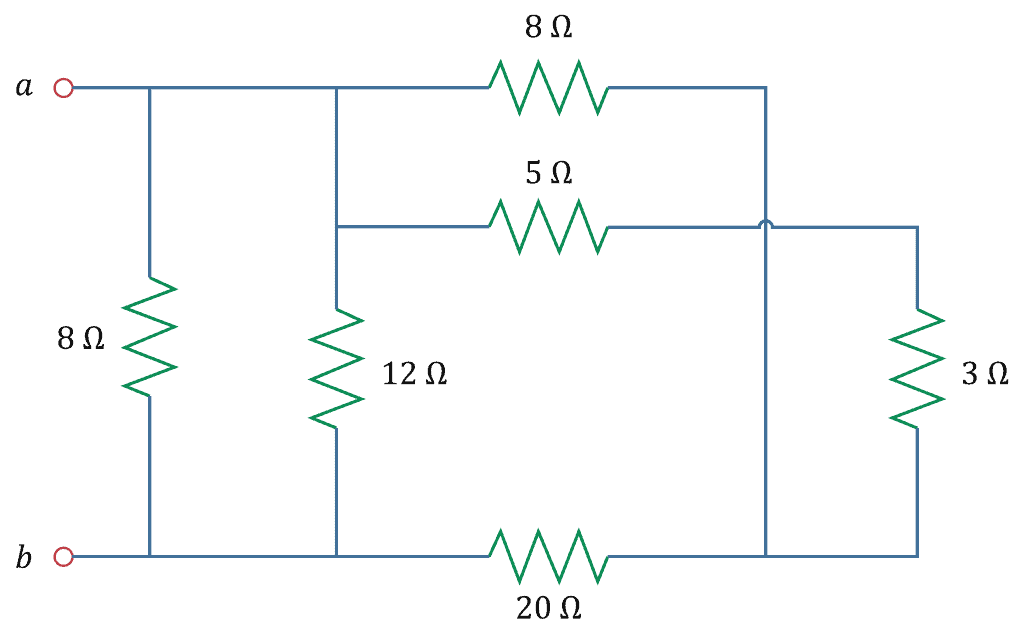
Figure 36 – Circuit diagram for Pb-18
Solution:
\small \begin{aligned} &R_{ab} = (((((5 + 3)||8) + 20)||8||12) \\[2ex] &\Rightarrow R_{ab} = \left(\left(((5 + 3)^{-1} + 8^{-1})^{-1} + 20\right)^{-1} + 8^{-1} + 12^{-1}\right)^{-1} \\[2ex] &\therefore R_{ab} = 4 \ \Omega \end{aligned}
Problem 19
Pb-19: Find equivalent resistance between a-b in the following circuit
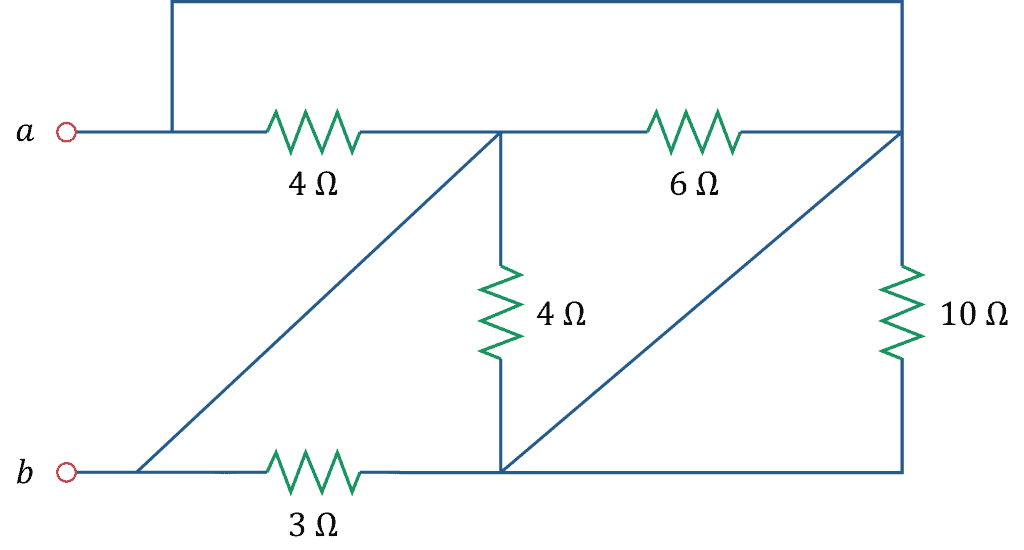
Figure 37 – Circuit diagram for Pb-19
Solution:
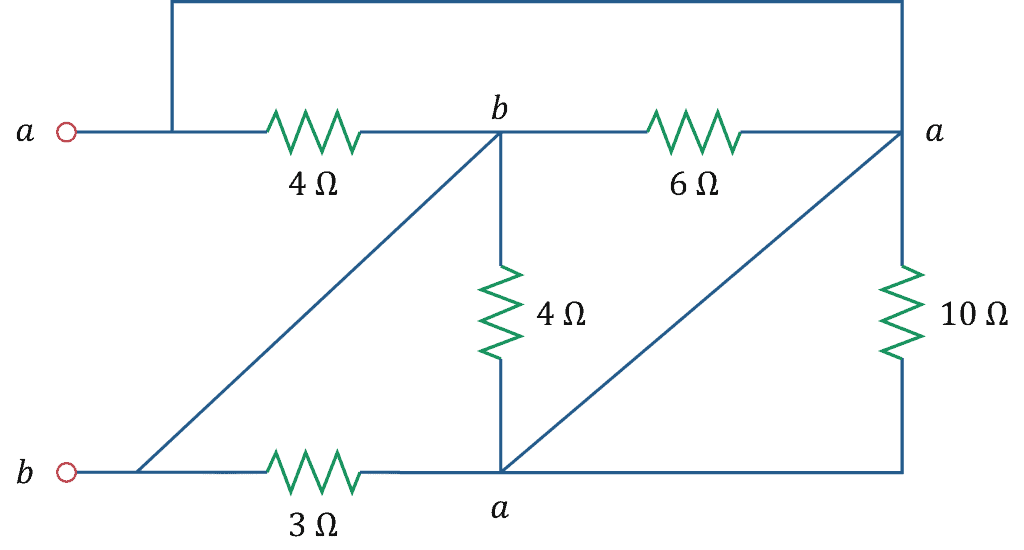
Figure 38 – Circuit diagram for solving the Pb-19
The resistors connected between the same nodes, a-a, will be short circuited.
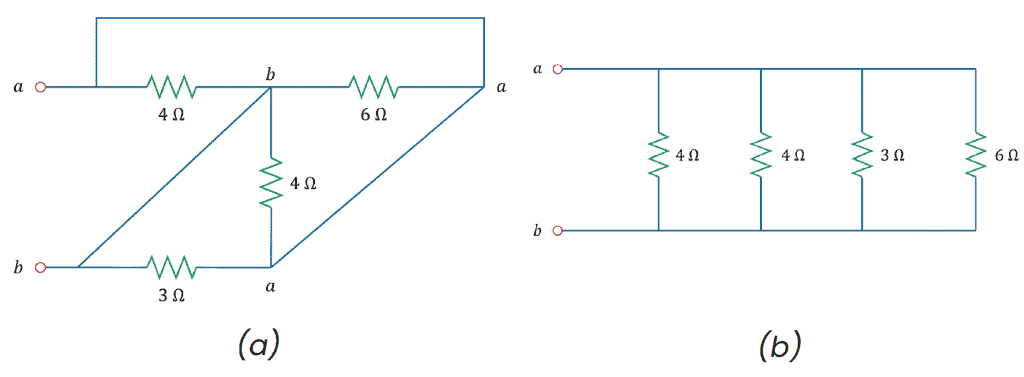
Figure 39 – Circuit diagram for solving the Pb-19 (simplifying the circuit in Fig. 38)
\small \begin{aligned} &R_{ab} = (4||4||3||6) \\[2ex] &\Rightarrow R_{ab} = (4^{-1} + 4^{-1} + 3^{-1} + 6^{-1})^{-1} \\[2ex] &\therefore R_{ab} = 1 \ \Omega \end{aligned}
Problem 20
Pb-20: Find I in the following circuit.
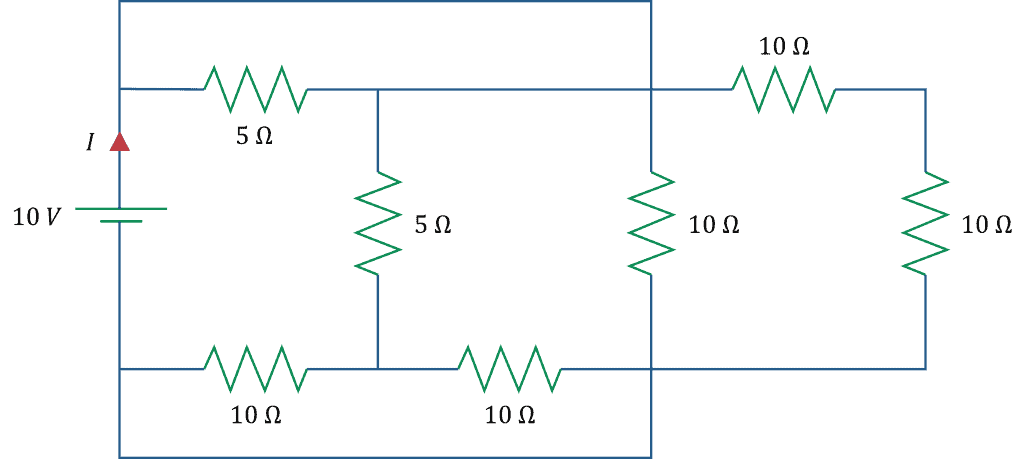
Figure 40 – Circuit diagram for Pb-20
Solution:
Simplifying the circuit,
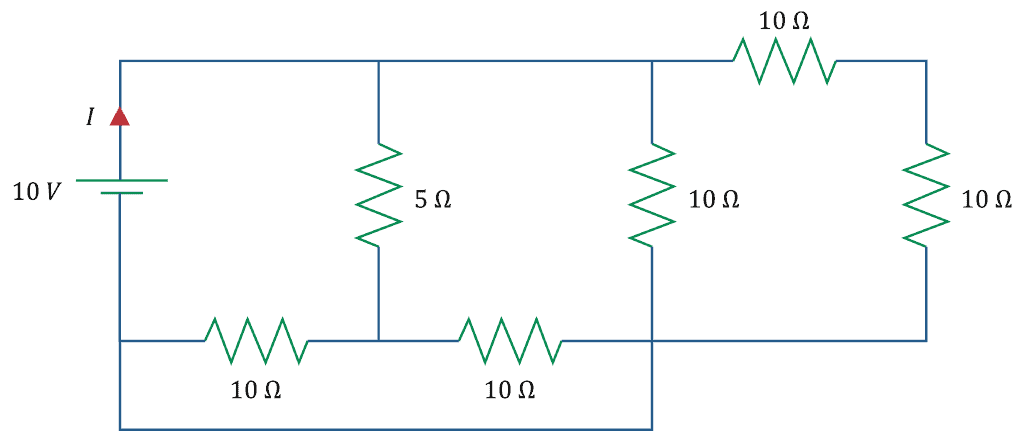
Figure 41 – Circuit diagram for solving the Pb-20
\small \begin{aligned} &R_{eq} = (((10||10) + 5)||10||(10 + 10)) \\[2ex] &\Rightarrow R_{eq} = \left(\left((10^{-1} + 10^{-1})^{-1} + 5\right)^{-1} + 10^{-1} + (10 + 10)^{-1}\right)^{-1} \\[2ex] &\therefore R_{eq} = 4 \ \Omega \\[2ex] &\therefore I = \frac{10}{R_{eq}} = \frac{10}{4} = 2.5 \ A \end{aligned}
Problem 21
Pb-21: Find R_{ab} and R_{cd} .
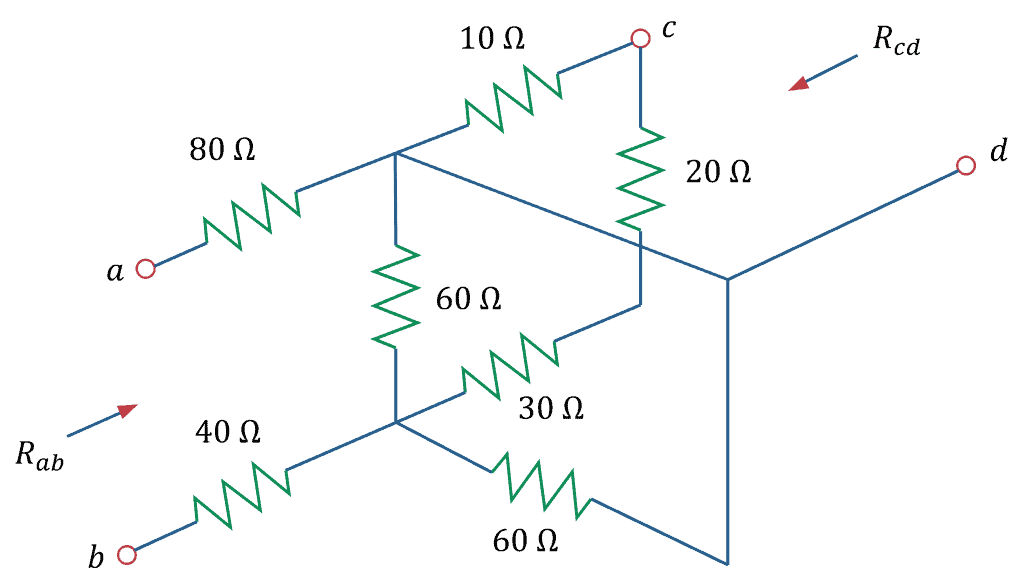
Figure 42 – Circuit diagram for Pb-21
Solution:
Simplifying the circuit,
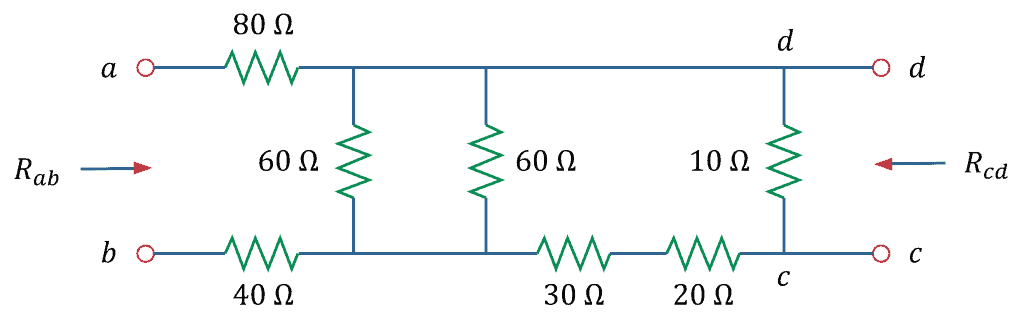
Figure 43 – Circuit diagram for solving the Pb-21
\small \begin{aligned} &R_{ab} = ((30 + 20 + 10)||60||60) + 40 + 80 \\[2ex] &\Rightarrow R_{ab} = \left((30 + 20 + 10)^{-1} + 60^{-1} + 60^{-1}\right)^{-1} + 40 + 80 \\[2ex] &\therefore R_{ab} = 140 \ \Omega \\[3.5ex] &R_{cd} = (((60||60) + 30 + 20)||10) \\[2ex] &\Rightarrow R_{cd} = \left(((60^{-1} + 60^{-1})^{-1} + 30 + 20)^{-1} + 10^{-1}\right)^{-1} \\[2ex] &\therefore R_{cd} = 8.89 \ \Omega \end{aligned}
Problem 22
Pb-22: Find I_1 and I_2 .
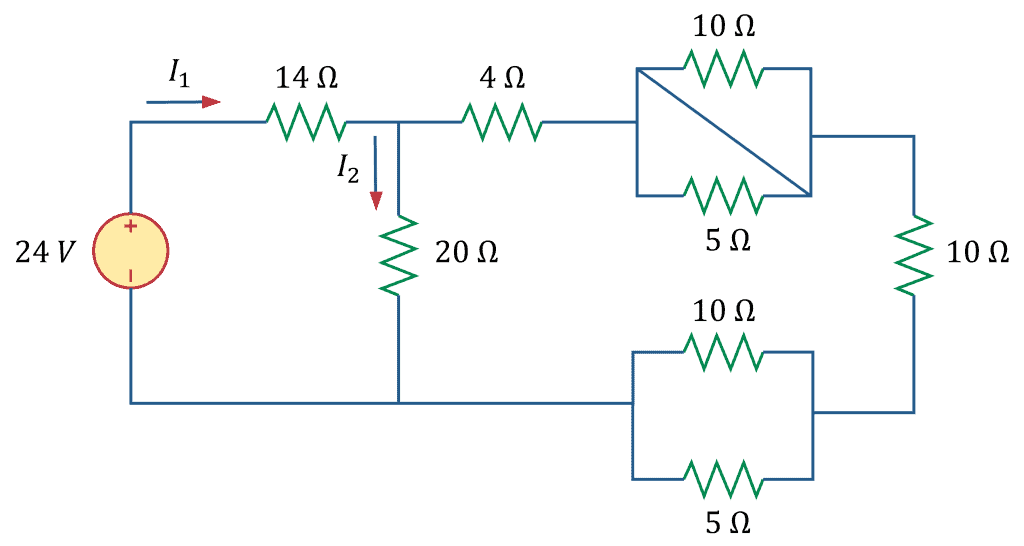
Figure 44 – Circuit diagram for Pb-22
Solution:
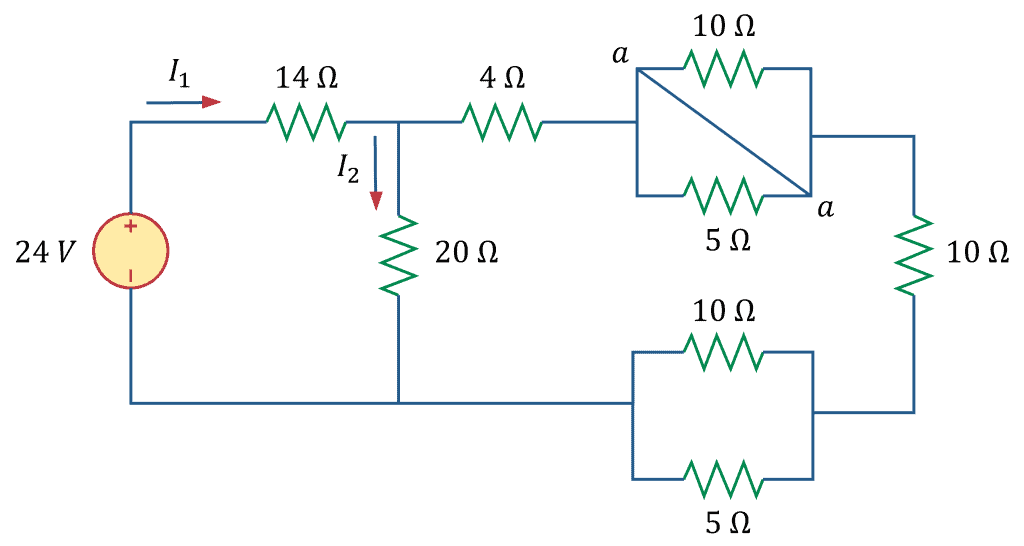
Figure 45 – Circuit diagram for solving the Pb-22
The resistors connected between the same nodes, a-a, will be short circuited.
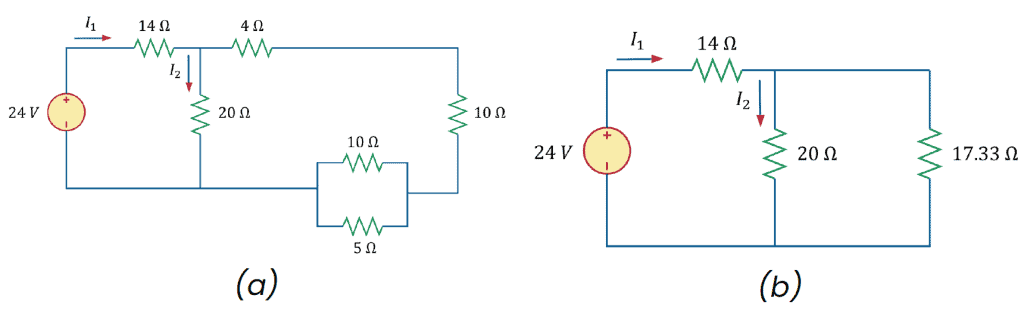
Figure 46 – Circuit diagram for solving the Pb-22 (simplifying the circuit in Fig. 45)
\small \begin{aligned} &R_{eq} = (20||17.33) + 14 \\[2ex] &\Rightarrow R_{eq} = (20^{-1} + 17.33^{-1})^{-1} + 14 \\[2ex] &\therefore R_{eq} = 23.28 \ \Omega \\[2ex] &\therefore I_1 = \frac{24}{R_{eq}} = \frac{24}{23.28} = 1.03 \ A \\[2ex] &\text{Using current division rule,} \\[2ex] &I_2 = \frac{(20||17.33)}{20} \times I_1 \\[2ex] &\Rightarrow I_2 = \frac{(20^{-1} + 17.33^{-1})^{-1}}{20} \times 1.03 \\[2ex] &\therefore I_2 = 0.48 \ A \end{aligned}
Problem 23
Pb-23: Find I for the circuit below.
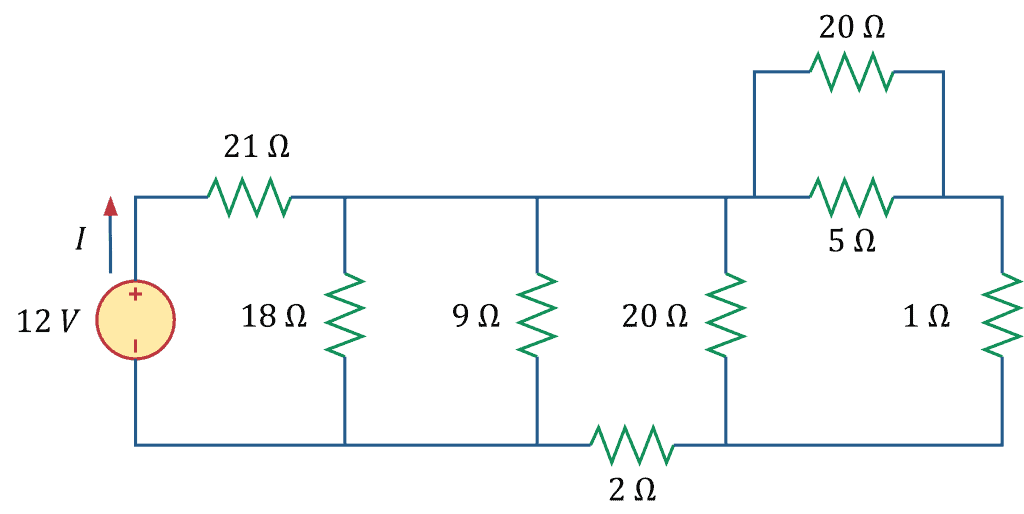
Figure 47 – Circuit diagram for Pb-23
Solution:
\small \begin{aligned} &R_{eq} = (((((20||5) + 1)||20) + 2)||9||18) + 21 \\[2ex] & \scriptsize{\Rightarrow R_{eq} = \Bigg(\bigg(\Big(\big((20^{-1} + 5^{-1})^{-1} + 1\big)^{-1} + 20^{-1}\Big)^{-1} + 2\bigg)^{-1} + 9^{-1} + 18^{-1}\Bigg)^{-1} + 21} \\[2ex] &\therefore R_{eq} = 24 \ \Omega \\[2ex] &\therefore I = \frac{12}{R_{eq}} = \frac{12}{24} = 0.5 \ A \end{aligned}
Problem 24
Pb-24: Find equivalent capacitance across the terminals a-b for the below circuit.
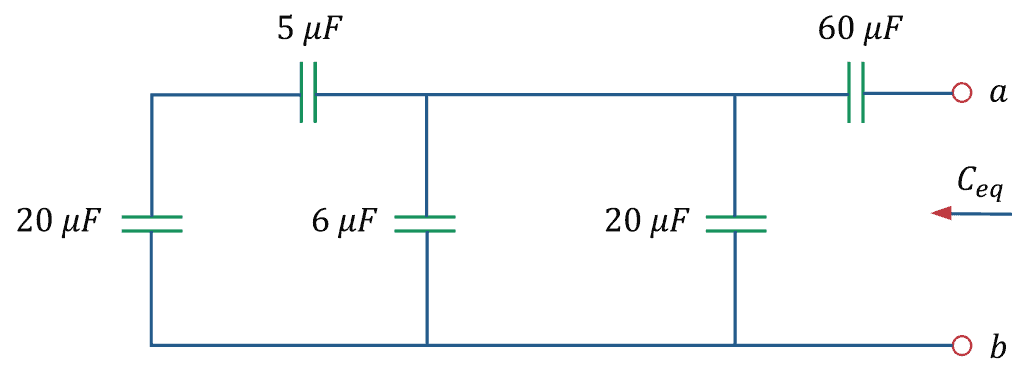
Figure 48 – Circuit diagram for Pb-24
Solution:
\small \begin{aligned} &C_{eq} = \Big(\big((20^{-1} + 5^{-1})^{-1} + 6 + 20\big)^{-1} + 60^{-1}\Big)^{-1} \\[2ex] &\therefore C_{eq} = 20 \ \mu F \end{aligned}
Working through these 24 problems provides a practical look at how series and parallel equivalent formulas actually operate in DC circuit analysis. While the core equations for resistors, inductors, and capacitors are relatively straightforward, applying them to intentionally tangled circuit diagrams is where the real challenge lies.
Read Also: Basic Laws of Electrical Circuits