
Mastering Circuits!
Mastering the basic concepts of Communication Systems is the foundation for every student and aspiring engineer in our interconnected world. In this comprehensive guide, we break down the essential communication theory fundamentals, including the block diagram components (source, transmitter, channel, and receiver) alongside with a fundamental introduction to key principles like bandwidth, noise, and modulation. You will also explore the critical relationship between signal-to-noise ratio and Shannon’s Capacity Theorem. Whether you are preparing for an exam or refreshing your knowledge, join Mastering Circuits as we solve practical problems to help you bridge the gap between theory and practice.
Communication Process
Communication is the process of establishing connection (or link) between two points for information exchange.
For communication to take place, three essential things are required. i.e.,
- Sender or Transmitter: It sends information. For example: TV Transmitting Station, Radio Transmitting Station. (Since they transmit information.)
- Receiver: It receives information. For example: TV Sets and Radio. (They receive information from transmitter.)
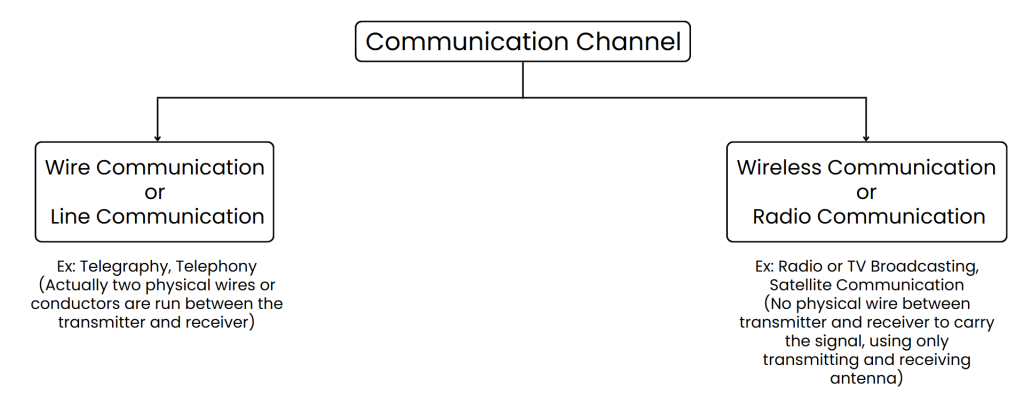
- Communication Channel: This is the path through which the signal propagates from transmitter to receiver.
- In case of wired connection, it is also called Line Communication Channel.
- In case of wireless connection, it is also called Radio Communication Channel.
Elements of Communication Systems
Communication involves the transfer of information from one point to another through a succession of processes.

Figure 1 – Communication System Block Diagram
In our day-to-day life, we have information in the form of sound, picture, speech, data and etc. To send this type of information over a long distance, we first convert the information in electrical form with the help of input transducer. After converting the information in electrical form, it is sufficient for transmitting via transmitter (an electronic circuit in which there is a modulation process). While transmitting information over a communication channel, there may be noise. This noise is additive in nature. So, the information is transmitted over a communication channel with some noise. This information is received via receiver (an electronic circuit in which there is a demodulation process). After receiving information in electrical form, output transducer is used to get information in original form.
The elements of communication systems are as follows:
- Information
- Transmitter
- Communication Channel or Medium
- Noise
- Receiver
- Information: The communication systems communicate messages. The messages come from the information sources. It may contain human voice, picture, data, music and their combination.
- Input Transducer: Ex. Microphones, TV Cameras and etc.
- Transmitter: The transmitter is a collection of electronic circuits designed to convert the information into a signal suitable for transmission over a given communication medium.
- Communication Channel: The communication channel is the medium by which the electronic signal is transmitted from one place to another. Ex. conducting wire, coaxial cable, optical fiber cable or free space.
- Depending on the type of communication medium, it is two types:
- Guided (Wired) Communication Channels are Twisted Pair Cable, Coaxial Cable, Optical Fiber.
- Unguided (Wireless) Communication Channels are Terrestrial Micro-Wave, Satellite Micro-Wave, Broadcast Radio.
- Depending on the type of communication medium, it is two types:
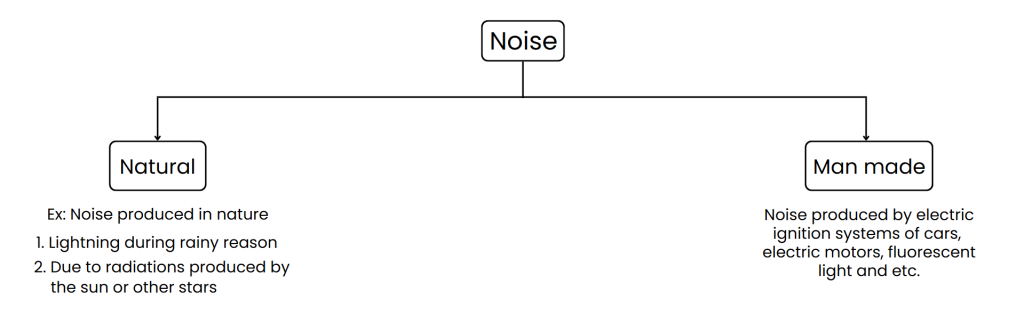
- Noise: Noise is random, undesirable electrical energy that enters the communication system via the medium and interferes with the transmitted message. Some noise is also produced in the receiver.
- Receiver: A receiver is a collection of electronic circuits designed to convert the signal back to the original information. It consists of amplifiers, detector, mixer, oscillators, transducers and so on.
- Output Transducer: Convert the electrical signal back to original form. Ex: loud speakers, picture tubes, computer monitor and etc.
Modulation Techniques
In the modulation process, two signals are used namely:
Low frequency \mathbf{m(t)} ; The modulating signal / baseband / message signal.
High frequency \mathbf{c(t)} ; The carrier signal (Sinusoidal signal).
- In the modulation process, some parameter of the carrier wave (such as Amplitude, Frequency or Phase) is varied in accordance with the modulating signal.
- Ex:
- Amplitude Modulation (AM)
- Frequency Modulation (FM)
- Phase Modulation (PM)
- After modulation process, we get Modulated Signal.
- Ex:
- This modulation signal is then transmitted by the transmitter. The receiver will “Demodulate” the received modulated signal and get the original signal back. Thus, demodulation is exactly opposite to the modulation.
- In the modulation process, the baseband signal (such as video etc.) modifies another higher frequency signal called the carrier. The carrier is usually a sinusoidal wave that is higher in frequency than the highest baseband signal frequency.
- The baseband signal modifies the amplitude, frequency or phase of the carrier in the modulation process.
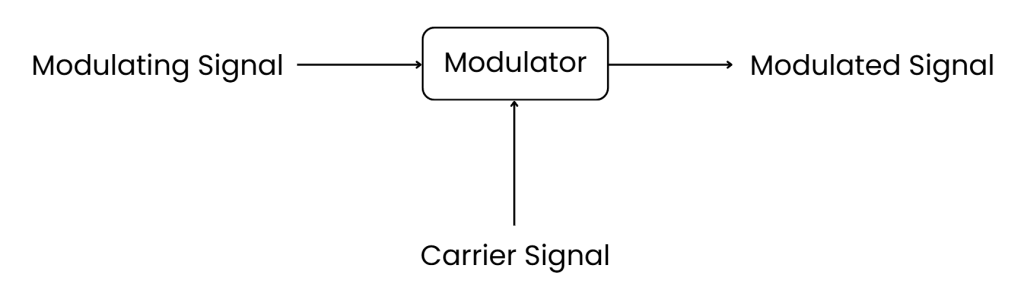
- In the process of modulation, the carrier wave actually act as a carrier which carries the information signal (modulating signal) from the transmitter to receiver.
- Similar to a situation in which a person travels in his car or on his bike from one place to another.
- The person can be viewed as the modulating signal and the car or bike as a carrier.
- Similar to a situation in which a person travels in his car or on his bike from one place to another.
Challenges in Communication
Challenges in communication primarily arise from channel impairments. These challenges set the theoretical and practical boundaries for how fast and reliably information can be transmitted.
Channel impairments: Attenuation, Distortion, Noise, Multi-User Interference.
The magnitude of the channel impairments depends on the type of channel.
- Attenuation: This is the gradual loss of signal amplitude as it travels through a medium.
- Signal attenuation or degradation exists in all media.
- Increases with distance.
- Wireless medium has the highest attenuation.
- Optical fibers have less attenuation.
- Distortion: Signals distort during travel through medium. Because different frequency components of a signal may be affected differently by the medium.
- Wire: Experiences frequency dependent attenuation, though generally resulting in the lowest distortion compared to other media.
- Optical Fiber: Distortion arises from delay differences in different modes and high dispersion.
- Wireless: Experiences the highest distortion due to multi path propagation (where the signal takes multiple paths to the receiver) and time-dependent randomness in the environment.
- Inter Symbol Interference: A major consequence of distortion where signals smear into one another, making it difficult for the user to distinguish individual bits.
- Noise: Undesirable, random electronic energy that enters the system and contaminates the transmitted energy.
- External Noise: Sources include man-made interference (e.g., faulty switches, fluorescent light, automobile ignition) and natural occurrences like lightning or cosmic radiation.
- Internal Noise: Generated within the electronic devices themselves due to thermal motion of electrons (Thermal Noise) or the random emission and recombination of charged carriers (Shot Noise).
Noise sets the fundamental limit on the maximum rate of communication.
The signal-to-noise ratio (SNR) is defined as the ratio of signal power to noise power.
SNR = \frac{Signal \, Power}{Noise \, Power}
- Multi-User Interference: Structured interference that arises from other users sharing the same or nearby spectrum. Common types include:
- Co-Channel Interference: Interference from user on the same frequency.
- Adjacent Channel Interference: Interference from signals in neighboring frequency bands.
Bandwidth in Communication
Bandwidth is a fundamental concept in communication systems and networking that describes the capacity of a transmission medium or the frequency range occupied by a signal.
Bandwidth is of two types:
- Signal Bandwidth: Signal bandwidth is the difference between the highest and lowest frequency components present in an information-bearing signal. It represents the width of the frequency spectrum occupied by the signal.
- Bandwidth of the baseband signal depends on the type of input message.
- Channel Bandwidth: Channel bandwidth refers to the range of frequencies that a physical transmission medium can successfully transport without significant attenuation or distortion. It is the measure of the capacity of the pipe through which the data flows.
- Common Transmission Media Capacities:
- Copper Wire: 1 MHz .
- Coaxial Cable: 100 MHz .
- Wireless: MHz for FM Radio, GHz for Satellite and 5G.
- Optical Fiber: THz
- Common Transmission Media Capacities:
Bandwidth of a communication channel must be equal to or greater than the bandwidth of the information.
Channel Capacity
Channel capacity represents the fundamental upper limit on the rate at which information can be transmitted error-free over a communication channel.
It is a central concept of information theory, first established by Claude Shannon in 1948.
Shannon’s Capacity Formula:
\small C = B \log_{2}(1 + SNR) \text{ bps (bits per second)}
Where,
\small \begin{aligned} C &= \text{Capacity (bps)} \\ B &= \text{Channel Bandwidth ( } Hz) \\ SNR &= \frac{\textit{Signal Power}}{\textit{Noise Power}} \end{aligned}
Capacity increases linearly with bandwidth, but only logarithmically with signal strength.
Shannon’s limit tells us what can be achieved. But, it tells nothing on how to accomplish it.
Shannon’s Capacity Theorem
Shannon’s Capacity Theorem (specifically the Shannon-Hartley Theorem) establishes the maximum rate at which information can be transmitted over a communication channel with an arbitrarily small probability of error, given the presence of noise.
The capacity (C) of a channel is given by:
\small C = B \log_{2} \left( 1 + \frac{S}{N} \right) \text{ bps (bits per second)}
Where,
\small \begin{aligned} C &= \text{Capacity (bps)} \\ B &= \text{Channel Bandwidth ( } Hz) \\ \frac{S}{N} &= \text{Signal-to-Noise Ratio} \end{aligned}
A given communication system has a maximum rate of information C known as the channel capacity.
If the information rate R is less than C , then one can approach arbitrarily small error probabilities by using intelligent coding techniques.
Significance of Shannon’s Capacity Theorem:
- Possibility of Error-Free Communication: If the information rate (R) is less than the capacity (C) , it is possible to achieve arbitrarily small error probabilities using intelligent coding techniques.
- System Design Limit: It tells engineers what can be achieved but does not provide the specific method (modulation or coding) to accomplish it.
Solved Problems on SNR and Channel Capacity
Understanding Decibels
A decibel (dB) is a logarithmic unit used to express the ratio between two values of a physical quantity, most commonly power or intensity. In electrical engineering, it is the standard way to describe gains, losses, and signal levels.
The formula for power ratio in decibels is:
\small dB = 10 \log_{10} \left( \frac{P_{out}}{P_{in}} \right)
\small \Rightarrow \log_{10} \left( \frac{P_{out}}{P_{in}} \right) = \frac{dB}{10}
\small \therefore \frac{P_{out}}{P_{in}} = 10^{\left(\frac{dB}{10}\right)}
The formula for voltage ratio in decibels is:
\small dB = 20 \log_{10} \left( \frac{V_{out}}{V_{in}} \right)
\small \Rightarrow \log_{10} \left( \frac{V_{out}}{V_{in}} \right) = \frac{dB}{20}
\small \therefore \frac{V_{out}}{V_{in}} = 10^{\left(\frac{dB}{20}\right)}
Power ratio in decibels:
\small dB = 10 \log_{10} \left( \frac{P_{2}}{P_{1}} \right)
\small \therefore \frac{P_{2}}{P_{1}} = 10^{\left(\frac{dB}{10}\right)}
Power-based SNR in decibels:
\small SNR_{dB} = 10 \log_{10} \left( \frac{S}{N} \right)
\small \therefore \frac{S}{N} = 10^{\left(\frac{SNR_{dB}}{10}\right)}
Voltage-based SNR in decibels:
\small SNR_{dB} = 20 \log_{10} \left( \frac{V_{signal}}{ V_{noise}} \right)
\small \therefore \frac{V_{signal}}{V_{noise}} = 10^{\left(\frac{SNR_{dB}}{20}\right)}
SNR in \mathbf{dB} from \mathbf{dBm} unit:
\small SNR_{dB} = S_{dBm} - N_{dBm}
Watts \mathbf{(W)} : The SI unit of power. It is an absolute, linear measure of the rate of energy transfer.
1 \, mW = 10^{-3} \, W
\mathbf{dB} (Decibel): A dimensionless, logarithmic unit used to express a ratio between two power levels. It does not represent an absolute amount of power on its own; it describes gain or loss.
\small dB = 10 \log_{10} \left( \frac{P_{2}}{P_{1}} \right)
\mathbf{dBW} (decibel-watt): An absolute unit of power referenced to 1 \, W
There is a formula to convert dBW to W .
\mathbf{dBm} (decibel-milliwatt): An absolute unit of power referenced to 1 \, mW
There is a formula to convert dBm to mW .
Conversions:
\small \begin{aligned} & \bullet \quad P_{dBW} = 10 \log_{10}(P_{W}) && [ \, dBW \leftrightarrow W \, ] \\[1.5ex] & \quad \Rightarrow \log_{10}(P_{W}) = \frac{P_{dBW}}{10} \\[1.5ex] & \quad \therefore P_{W} = 10^{\left( \frac{P_{dBW}}{10} \right)} \\[4ex] & \bullet \quad P_{dBm} = 10 \log_{10}(P_{mW}) && [ \, dBm \leftrightarrow mW \, ] \\[1.5ex] & \quad \Rightarrow \log_{10}(P_{mW}) = \frac{P_{dBm}}{10} \\[1.5ex] & \quad \therefore P_{mW} = 10^{\left( \frac{P_{dBm}}{10} \right)} \\[4ex] & \bullet \quad P_{dBW} = P_{dBm} - 30 && [ \, dBW \leftrightarrow dBm \, ] \\[1.5ex] & \quad \therefore P_{dBm} = P_{dBW} + 30 \end{aligned}
Problem 1
Pb-1: The output power from an audio amplifier is 10 \, W when the signal frequency is 1 \, kHz . At a signal frequency of 10 \, kHz , the output power is 1 \, W . Calculate the dB change in power.
Solution:
\small \begin{aligned} dB \, \, \text{change in power} &= 10 \log_{10} \left( \frac{P_{2}}{P_{1}} \right) \\ &= 10 \times \log_{10} \left( \frac{1}{10} \right) \\ &= -10 \, dB \end{aligned}
Problem 2
Pb-2: If the signal power of a signal is 0.52 \, mW and the noise power is 0.01 \, mW , determine the SNR ( in dB) .
Solution:
\small \begin{aligned} SNR_{dB} &= 10 \log_{10} \left( \frac{signal \ power}{noise \ power} \right) \\ &= 10 \log_{10} \left( \frac{0.52}{0.01} \right) \\ &= 17.16 \ dB \end{aligned}
Problem 3
Pb-3: In a voice channel, the signal power level is -3 \, dBm \, (0.5 \, mW) and the noise power level is -20 \, dBm \, (0.01 \, mW) . What is the Signal-to-Noise Ratio (SNR) in decibels ( in dB) ?
Solution:
\small \begin{aligned} SNR_{dB} &= S_{dBm} - N_{dBm} \\ &= -3 - (-20) \\ &= 17 \ dB \end{aligned}
Problem 4
Pb-4: What is the SNR ( in dB) of a voice channel if the signal power level is 1.04 \, mW and noise level is 0.02 \, mW ?
Solution:
\small \begin{aligned} SNR_{dB} &= 10 \log_{10} \left( \frac{S}{N} \right) \\ &= 10 \log_{10} \left( \frac{1.04}{0.02} \right) \\ &= 17.16 \ dB \end{aligned}
Problem 5
Pb-5: Bandwidth = 2.4 \, kHz , SNR = 20 \, dB , what is bit rate?
Solution:
\small \begin{aligned} &\text{Here,} \\[2ex] & \quad B = 2.4 \ kHz = 2.4 \times 10^{3} \ Hz = 2400 \ Hz \\[2ex] & \quad SNR_{dB} = 20 \ dB \\[2ex] & \quad \Rightarrow 10 \log_{10} \left( \frac{S}{N} \right) = 20 \\[2ex] & \quad \therefore \frac{S}{N} = 10^{\left( \frac{20}{10} \right)} = 100 \\[2ex] &\text{We know,} \\[2ex] & \quad C = B \log_{2} \left( 1 + \frac{S}{N} \right) \\[2ex] & \quad \quad = 2400 \times \log_{2} (1 + 100) \\[2ex] & \quad \quad = 15979.71 \ bits/sec \end{aligned}
Problem 6
Pb-6: If a 300 \text{ - } 3300 \, kHz channel has 2 \, MW signal power and 1.95 \, MW noise power, then find the channel capacity.
Solution:
\small \begin{aligned} &\text{Here,} \\[2.5ex] & \quad B = (3300 - 300) \ Hz = 3000 \ Hz \\[2.5ex] & \quad S = 2 \ MW \\[2.5ex] & \quad N = 1.95 \ MW \\[2.5ex] &\text{We know,} \\[2.5ex] & \quad C = B \log_{2} \left( 1 + \frac{S}{N} \right) \\[2.5ex] & \quad \quad = 3000 \times \log_{2} \left( 1 + \frac{2}{1.95} \right) \\[2.5ex] & \quad \quad = 3055.14 \ bps \end{aligned}
Problem 7
Pb-7: The bandwidth of a signal is 10 \, kHz and SNR is 12 \, dB . Find the bit rate of the binary PCM.
Solution:
\small \begin{aligned} &\text{Here,} \\[2ex] & \quad B = 10 \ kHz = 10 \times 10^{3} \ Hz = 10^{4} \ Hz \\[2ex] & \quad SNR_{dB} = 12 \ dB \\[2ex] & \quad \Rightarrow 10 \log_{10} \left( \frac{S}{N} \right) = 12 \\[2ex] & \quad \therefore \frac{S}{N} = 10^{\left( \frac{12}{10} \right)} = 15.85 \\[2ex] &\text{We know,} \\[2ex] & \quad C = B \log_{2} \left( 1 + \frac{S}{N} \right) \\[2ex] & \quad \quad = 10^{4} \times \log_{2} (1 + 15.85) \\[2ex] & \quad \quad = 40746.77 \ bits/sec \end{aligned}
Problem 8
Pb-8: A voice grade channel of telephone network has a bandwidth of 3.4 \, kHz . Calculate the information capacity of the channel for a signal to noise ratio of 30 \, dB .
Solution:
\small \begin{aligned} &\text{Here,} \\[2ex] & \quad B = 3.4 \ kHz = 3.4 \times 10^{3} \ Hz = 3400 \ Hz \\[2ex] & \quad SNR_{dB} = 30 \ dB \\[2ex] & \quad \Rightarrow 10 \log_{10} \left( \frac{S}{N} \right) = 30 \\[2ex] & \quad \therefore \frac{S}{N} = 10^{\left( \frac{30}{10} \right)} = 1000 \\[2ex] &\text{We know,} \\[2ex] & \quad C = B \log_{2} \left( 1 + \frac{S}{N} \right) \\[2ex] & \quad \quad = 3400 \times \log_{2} (1 + 1000) \\[2ex] & \quad \quad = 33888.57 \ bps \end{aligned}
Problem 9
Pb-9: State Shannon’s capacity theorem. In a communication channel, signal to noise ratio is 8 \, dB and channel bandwidth is 4.5 \, kHz . Find channel capacity.
Solution:
Shannon’s capacity theorem establishes the maximum rate at which information can be transmitted over a communication channel with an arbitrarily small probability of error, given the presence of noise.
The capacity (C) of a channel is given by:
\small C = B \log_{2} \left( 1 + \frac{S}{N} \right) \text{ bps (bits per second)}
Where,
\small \begin{aligned} C &= \text{Capacity (bps)} \\ B &= \text{Channel Bandwidth ( } Hz) \\ \frac{S}{N} &= \text{Signal-to-Noise Ratio} \end{aligned}
\small \begin{aligned} &\text{Here,} \\[2ex] & \quad B = 4.5 \ kHz = 4.5 \times 10^{3} \ Hz = 4500 \ Hz \\[2ex] & \quad SNR_{dB} = 8 \ dB \\[2ex] & \quad \Rightarrow 10 \log_{10} \left( \frac{S}{N} \right) = 8 \\[2ex] & \quad \therefore \frac{S}{N} = 10^{\left( \frac{8}{10} \right)} = 6.31 \\[2ex] &\text{We know,} \\[2ex] & \quad C = B \log_{2} \left( 1 + \frac{S}{N} \right) \\[2ex] & \quad \quad = 4500 \times \log_{2} (1 + 6.31) \\[2ex] & \quad \quad = 12914.42 \ bps \end{aligned}
Problem 10
Pb-10: The bandwidth of a digital transmission line is 1 \, Hz . If the signal to noise ratio is 30 \, dB , find the maximum capacity for binary data transmission.
Solution:
\small \begin{aligned} &\text{Here,} \\[2ex] & \quad B = 1 \ Hz \\[2ex] & \quad SNR_{dB} = 30 \ dB \\[2ex] & \quad \Rightarrow 10 \log_{10} \left( \frac{S}{N} \right) = 30 \\[2ex] & \quad \therefore \frac{S}{N} = 10^{\left( \frac{30}{10} \right)} = 1000 \\[2ex] &\text{We know,} \\[2ex] & \quad C = B \log_{2} \left( 1 + \frac{S}{N} \right) \\[2ex] & \quad \quad = 1 \times \log_{2} (1 + 1000) \\[2ex] & \quad \quad = 9.9672 \ bps \end{aligned}
Problem 11
Pb-11: If 300 \text{ - } 3400 \, Hz channel has 1 \, mW signal power and -40 \, dBm noise, what is the Shannon’s capacity?
Solution:
\small \begin{aligned} &\text{Here,} \\[2.5ex] & \quad B = (3400 - 300) \ Hz = 3100 \ Hz \\[2.5ex] & \quad S_{mW} = 1 \ mW \\[2.5ex] & \quad N_{dBm} = -40 \ dBm \\[2ex] & \quad \Rightarrow 10 \log_{10} \left( N_{mW} \right) = -40 \\[2ex] & \quad \therefore N_{mW} = 10^{\left( - \frac{40}{10} \right)} = 10^{-4} \ mW \\[2.5ex] &\text{We know,} \\[2.5ex] & \quad C = B \log_{2} \left( 1 + \frac{S_{mW}}{N_{mW}} \right) \\[2.5ex] & \quad \quad = 3100 \times \log_{2} \left( 1 + \frac{1}{10^{-4}} \right) \\[2.5ex] & \quad \quad = 41192.36 \ bps \end{aligned}
Problem 12
Pb-12: A signal having 300 \text{ - } 3400 \, Hz frequency has 1 \, mW signal power. If noise power is -20 \, dBm , find Shannon’s capacity.
Solution:
\small \begin{aligned} &\text{Here,} \\[2.5ex] & \quad B = (3400 - 300) \ Hz = 3100 \ Hz \\[2.5ex] & \quad S_{mW} = 1 \ mW \\[2.5ex] & \quad N_{dBm} = -20 \ dBm \\[2ex] & \quad \Rightarrow 10 \log_{10} \left( N_{mW} \right) = -20 \\[2ex] & \quad \therefore N_{mW} = 10^{\left( - \frac{20}{10} \right)} = 0.01 \ mW \\[2.5ex] &\text{We know,} \\[2.5ex] & \quad C = B \log_{2} \left( 1 + \frac{S_{mW}}{N_{mW}} \right) \\[2.5ex] & \quad \quad = 3100 \times \log_{2} \left( 1 + \frac{1}{0.01} \right) \\[2.5ex] & \quad \quad = 20640.4556 \ bps \end{aligned}
Problem 13
Pb-13: A telephone line is used to send signal having 300 \text{ - } 3200 \, Hz frequency. Calculate maximum possible data rate if the line has 20 \, dB SNR.
Solution:
\small \begin{aligned} &\text{Here,} \\[2ex] & \quad B = (3200 - 300) \ Hz = 2900 \ Hz \\[2ex] & \quad SNR_{dB} = 20 \ dB \\[2ex] & \quad \Rightarrow 10 \log_{10} \left( \frac{S}{N} \right) = 20 \\[2ex] & \quad \therefore \frac{S}{N} = 10^{\left( \frac{20}{10} \right)} = 100 \\[2ex] &\text{We know,} \\[2ex] & \quad C = B \log_{2} \left( 1 + \frac{S}{N} \right) \\[2ex] & \quad \quad = 2900 \times \log_{2} (1 + 100) \\[2ex] & \quad \quad = 19308.8133 \ bps \end{aligned}
Problem 14
Pb-14: Determine the capacity of a voice-grade telephone channel with a bandwidth of 3400 \, Hz and an SNR of 30 \, dB . Also, determine the minimum SNR required to transmit 4.8 \, kbps of data.
Solution:
\small \begin{aligned} &\text{Here,} \\[2ex] & \quad B = 3400 \text{ Hz} \\[2ex] & \quad SNR_{dB} = 20 \text{ dB} \\[2ex] & \quad \Rightarrow 10 \log_{10} \left( \frac{S}{N} \right) = 30 \\[2ex] & \quad \therefore \frac{S}{N} = 10^{\left( \frac{30}{10} \right)} = 1000 \\[2ex] &\text{We know,} \\[2ex] & \quad C = B \log_{2} \left( 1 + \frac{S}{N} \right) \\[2ex] & \quad \quad = 3400 \times \log_{2} (1 + 1000) \\[2ex] & \quad \quad = 33888.56928 \text{ bps} \\[2ex] &\text{Minimum SNR for } 4.8 \text{ kbps,} \\[2ex] & \quad 4800 = 3400 \times \log_{2} (1 + SNR_{new}) \\[2ex] & \quad \Rightarrow \log_{2} (1 + SNR_{new}) = \frac{4800}{3400} \\[2ex] & \quad \Rightarrow 1 + SNR_{new} = 2^{\left( \frac{4800}{3400} \right)} \\[2ex] & \quad \Rightarrow SNR_{new} = 2^{\left( \frac{4800}{3400} \right)} - 1 \\[2ex] & \quad \Rightarrow SNR_{new} = 1.66 \\[2ex] & \quad \Rightarrow (SNR_{new})_{dB} = 10 \log_{10} (1.66) \\[2ex] & \quad \therefore (SNR_{new})_{dB} = 2.20 \text{ dB} \end{aligned}
Problem 15
Pb-15: A voice grade telephone line transmits frequencies 300 \, Hz to 3400 \, Hz with an SNR of 45 \, dB . Determine the capacity of the line. What must be the SNR if the channel capacity is increased by 10\% while bandwidth remains same.
Solution:
\small \begin{aligned} &\text{Here,} \\[2.5ex] & \quad B = (3400 - 300) = 3100 \ Hz \\[2.5ex] & \quad SNR_{dB} = 45 \ dB \\[2.5ex] & \quad \Rightarrow 10 \log_{10} \left( \frac{S}{N} \right) = 45 \\[2.5ex] & \quad \therefore \frac{S}{N} = 10^{\left( \frac{45}{10} \right)} = 31622.7766 \\[2.5ex] &\text{We know,} \\[2.5ex] & \quad C = B \log_{2} \left( 1 + \frac{S}{N} \right) \\[2.5ex] & \quad \quad = 3100 \times \log_{2} (1 + 31622.7766) \\[2.5ex] & \quad \quad = 46341.04 \ bps \\[2.5ex] &\text{If the channel capacity is increased by 10\% and} \\[1ex] &\text{bandwidth remains same,} \\[2.5ex] & \quad 1.1C = B \log_{2} (1 + SNR_{new}) \\[2.5ex] & \quad \Rightarrow 1.1 \times 46341.04 = 3100 \times \log_{2} (1 + SNR_{new}) \\[2.5ex] & \quad \Rightarrow \log_{2} (1 + SNR_{new}) = 16.44 \\[2.5ex] & \quad \Rightarrow 1 + SNR_{new} = 2^{(16.44)} \\[2.5ex] & \quad \Rightarrow SNR_{new} = 2^{(16.44)} - 1 \\[2.5ex] & \quad \Rightarrow SNR_{new} = 88905.42 \\[2.5ex] & \quad \Rightarrow (SNR_{new})_{dB} = 10 \log_{10} (88905.42) \\[2.5ex] & \quad \therefore (SNR_{new})_{dB} = 49.49 \ dB \end{aligned}
Solved Problems on Bit Error Rate (BER)
Bit Error Rate (BER) measures the percentage of bits received incorrectly.
\small BER = \frac{\textit{Number of errored bits}}{\textit{Total bits transmitted}} \times 100\%
Problem 16
Pb-16: A transmitter is transmitting data at a rate of 65 \, bps . At the receiver, the error detector detects 32 errors in the received bits in 15 seconds of the data transmission. Calculate Bit Error Rate (BER) of the communication system.
Solution:
\small \begin{aligned} & \text{Here,} \\[2.5ex] & \quad \text{Total bits transmitted} = 65 \times 15 = 975 \textit{ bits} \\[2.5ex] & \quad \text{Number of errored bits} = 32 \textit{ bits} \\[2.5ex] & \text{We know,} \\[2.5ex] & \quad BER = \frac{\textit{Number of errored bits}}{\textit{Total bits transmitted}} \times 100\% \\[2.5ex] & \quad \phantom{BER} = \frac{32}{975} \times 100\% \\[2.5ex] & \quad \phantom{BER} = 3.28\% \end{aligned}
Problem 17
Pb-17: Suppose a substation SCADA system transmit the measured data to control center over wireless channel. The data transmission rate is 64 \, bps . The receiver at the control center detects 30 errors in the received signal in 10 seconds of data transmission. Calculate the BER of the communication system.
Solution:
\small \begin{aligned} & \text{Here,} \\[2.5ex] & \quad \text{Total bits transmitted} = 64 \times 10 = 640 \textit{ bits} \\[2.5ex] & \quad \text{Number of errored bits} = 30 \textit{ bits} \\[2.5ex] & \text{We know,} \\[2.5ex] & \quad BER = \frac{\textit{Number of errored bits}}{\textit{Total bits transmitted}} \times 100\% \\[2.5ex] & \quad \phantom{BER} = \frac{30}{640} \times 100\% \\[2.5ex] & \quad \phantom{BER} = 4.6875\% \end{aligned}
Congratulations! You’ve successfully navigated the foundational building blocks of Communication Systems. This is the first major step toward total mastery of signal transmission and information theory. If any of these concepts, from the components of a block diagram to the Signal-to-Noise Ratio and Shannon’s Capacity Theorem, still feel a bit confusing, don’t hesitate to reach out. Drop a comment below with your questions, and let’s clear up the confusion together!
Read Also: Noise in Communication Systems